

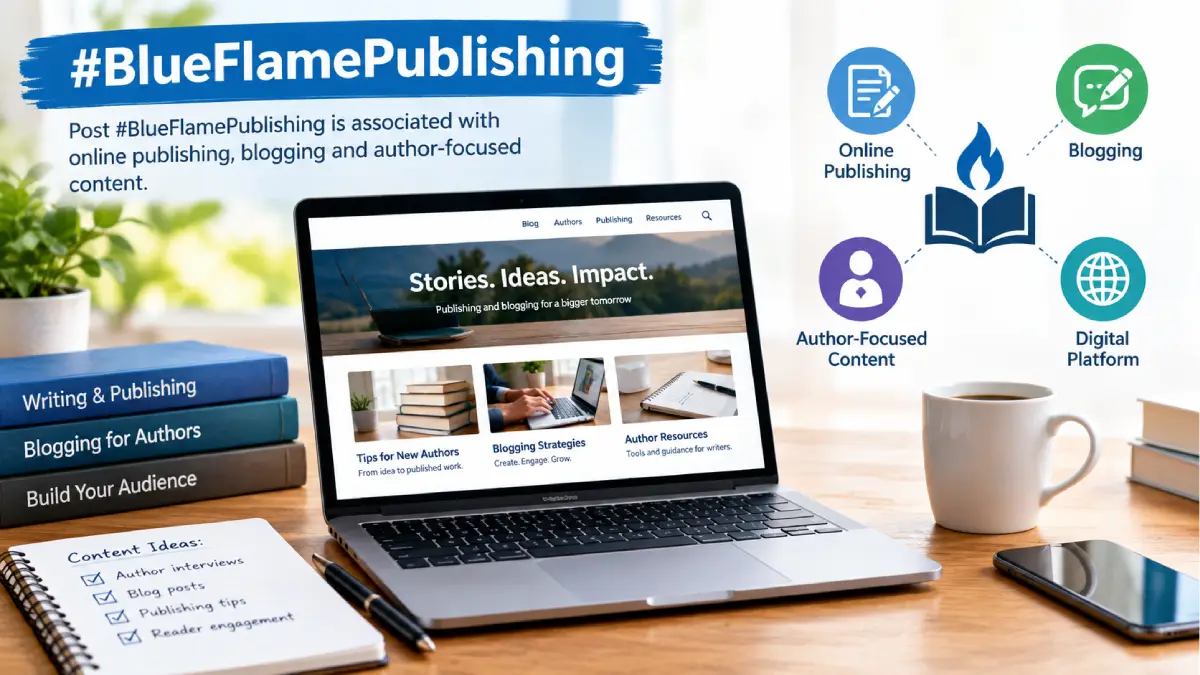
Post #BlueFlamePublishing is a search phrase associated with BlueFlamePublishing-related content, blogging, digital publishing and author-focused discussions online. The term can refer to posts published under the BlueFlamePublishing name or to the wider conversation around its blogging and publishing activities, but different websites currently describe the entity in different ways.
Table of Contents
What Is Post #BlueFlamePublishing?
If you have searched for post #blueflamepublishing, you may have noticed that the results do not all describe exactly the same thing.
The phrase appears across articles discussing BlueFlamePublishing, blogging, digital publishing, author promotion, content creation and social media. Some pages present BlueFlamePublishing as a blogging and writing community, while others describe it more broadly as a digital publishing platform.
For example, BlueFlamePublishing.org describes its purpose around writers, readers, creativity and sharing ideas. Its About Us page says the platform aims to connect writers and readers and publish content covering areas such as creativity, motivation and writing.
Meanwhile, BlueFlamePublishing.net has published pages specifically using the phrase “Post #BlueFlamePublishing” and discusses author marketing, publishing support, editing and reader engagement.
This difference matters.
Rather than assuming every website using the BlueFlamePublishing name belongs to one verified corporate organisation, it is more accurate to describe post #blueflamepublishing as a search term connected with an online publishing and blogging identity whose exact scope depends on the source being examined.
What Does “Post #BlueFlamePublishing” Mean?
The phrase can be understood in two parts.
“Post” generally refers to an article, blog entry, social media publication or other piece of online content.
“#BlueFlamePublishing” functions like a branded hashtag or keyword. It can help group content around the BlueFlamePublishing name.
Therefore, when someone searches for post #blueflamepublishing, they may be looking for:
- BlueFlamePublishing blog posts
- articles published under the BlueFlamePublishing name
- posts using the #BlueFlamePublishing hashtag
- information about the publishing platform
- author and blogging resources
- publishing-related discussions
- BlueFlamePublishing’s online presence
- explanations of specific BlueFlamePublishing posts
The search intent is therefore broader than simply finding one article.
BlueFlamePublishing as an Online Publishing Concept
BlueFlamePublishing.org presents itself as a platform for people interested in writing, reading and sharing ideas. Its stated purpose includes giving writers a place to express themselves while allowing readers to discover different perspectives.
This places the name within the wider digital publishing ecosystem.
Digital publishing has changed significantly from traditional publishing. A writer no longer necessarily needs to produce a printed book before developing an audience. Blogs, newsletters, social platforms, online magazines and self-publishing services all provide ways to distribute written work.
A platform associated with this space may therefore have several potential functions:
- Content publication
- Blogging
- Author visibility
- Reader engagement
- Digital storytelling
- Content marketing
- Publishing education
- Online community building
However, these functions should not automatically be treated as confirmed features of every website using the BlueFlamePublishing name.
What Types of Content Are Associated With BlueFlamePublishing?
Search results currently show a fairly broad mixture of topics.
BlueFlamePublishing.org says that its content can cover technology, news and other general-interest subjects. Its homepage also contains articles on digital identities, business, technology and other topics.
Other BlueFlamePublishing-related pages focus more specifically on writing and publishing.
Common content categories include:
Writing and Creativity
These articles are aimed at people who enjoy writing, storytelling and creative expression.
Topics may include:
- writing techniques
- storytelling
- creativity
- author development
- blogging
- reader engagement
Digital Publishing
Digital publishing is another recurring theme.
This can include:
- self-publishing
- online distribution
- publishing strategies
- digital content
- author platforms
- book promotion
SEO and Content Marketing
Some BlueFlamePublishing-related articles discuss keywords, search visibility and content strategy.
That makes sense because publishing online is closely connected to discoverability.
A well-written article still needs to be found by readers, and SEO can help search engines understand what a page is about.
Technology and Digital Trends
Some pages associated with BlueFlamePublishing publish technology and digital-trend content alongside publishing-related subjects.
This broader approach means that visitors should not necessarily expect every post to focus exclusively on books or traditional publishing. For more related articles visit our website.
How Does a Typical BlueFlamePublishing Post Work?
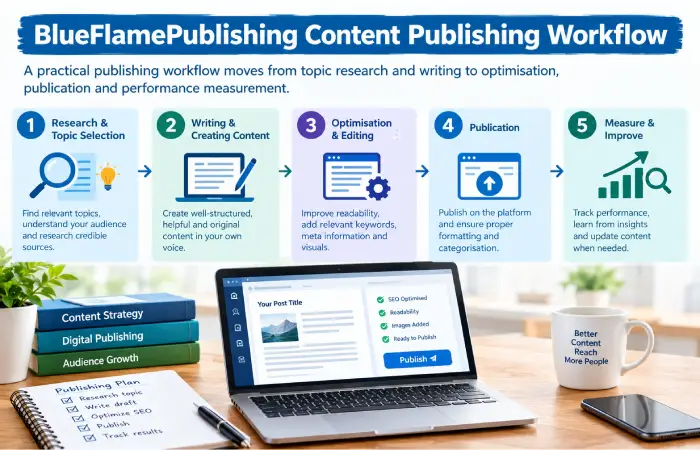
A typical digital publishing workflow is relatively straightforward.
Step 1: Choose a topic
The writer identifies a subject that has value for a specific audience.
For example:
- a writing tutorial
- a publishing guide
- a technology topic
- an author marketing strategy
- a blogging idea
Step 2: Research the subject
Good publishing starts with reliable research.
Writers should check:
- original sources
- dates
- statistics
- quotations
- names
- URLs
- industry terminology
This is particularly important for entity-based articles because online information can easily become mixed or duplicated.
Step 3: Create the article
The content should have a logical structure.
A useful structure is:
Introduction → Explanation → Evidence → Practical information → Limitations → Conclusion
Step 4: Optimise the article
Basic SEO can include:
- descriptive title
- primary keyword
- relevant headings
- concise meta description
- descriptive URL
- internal links
- authoritative external references
- useful images
- descriptive alt text
Step 5: Publish and promote
Once the article is published, the author can promote it through relevant social channels, communities, email lists or other appropriate distribution methods.
Step 6: Measure performance
Useful metrics include:
- impressions
- clicks
- organic traffic
- engagement
- referring links
- returning visitors
- conversions where applicable
Why Are People Searching for Post #BlueFlamePublishing?
The keyword appears to have several possible search intents.
| Search intent | What the user may want |
| Navigational | Find BlueFlamePublishing or related posts |
| Informational | Understand what BlueFlamePublishing is |
| Content discovery | Find published BlueFlamePublishing articles |
| Author intent | Learn about publishing or promotion |
| SEO intent | Understand the keyword or hashtag |
| Research intent | Check whether the platform is legitimate |
| Social intent | Find posts associated with the name |
This makes post #blueflamepublishing an interesting long-tail entity keyword.
It is not necessarily a keyword where the user wants to buy something immediately.
The user is more likely trying to understand or locate information.
Post #BlueFlamePublishing vs a Traditional Publishing House
It is important not to automatically equate an online blogging identity with a conventional publishing company.
Traditional publishing houses generally operate through formal editorial, acquisition, rights, production and distribution processes.
An online publishing platform may instead focus on articles, blogs, digital content or community participation.
| Factor | Traditional publisher | Online publishing platform |
| Main output | Books and formal publications | Blogs, articles or digital content |
| Editorial process | Usually structured | Can vary |
| Distribution | Booksellers and distributors | Websites and digital channels |
| Author participation | Usually selective | May be more open |
| Content frequency | Often project-based | Potentially frequent |
| SEO importance | Useful but secondary | Often highly important |
| Reader interaction | Usually limited | Often more direct |
| Social promotion | Supporting channel | Can be central |
This comparison helps explain why the phrase post #blueflamepublishing should not automatically be interpreted as referring to traditional book publishing.
Key Features to Look For in a Publishing Platform
If you are evaluating a website associated with BlueFlamePublishing or any similar digital publishing identity, look beyond the branding.
Clear editorial purpose
A credible publishing website should explain what it publishes and who its intended readers are.
Author information
Look for identifiable authors and useful author biographies.
An author page does not guarantee accuracy, but transparency makes content easier to evaluate.
Contact information
A legitimate publication should provide an appropriate way for readers or contributors to make contact.
BlueFlamePublishing.org has a contact page and identifies an email contact for communication.
Consistent publishing history
A website with a genuine publishing purpose will normally have an identifiable history of articles or other content.
Editorial transparency
Readers should be able to understand whether articles are:
- editorial content
- sponsored content
- guest posts
- advertisements
- contributor submissions
Corrections and updates
Good publishers should be willing to correct inaccurate information.
Is Post #BlueFlamePublishing Legitimate?
There is no simple yes-or-no answer because “BlueFlamePublishing” appears across multiple domains and publications.
For example, search results include BlueFlamePublishing.org and BlueFlamePublishing.net, alongside third-party websites publishing their own articles about the keyword.
This means readers should verify which specific website they are dealing with.
A domain using a familiar name does not automatically prove that it is the official website of an organisation.
Before relying on a website, check:
- The exact domain name
- About page
- Contact information
- Author identity
- Publication dates
- Editorial policies
- External references
- Whether claims can be independently verified
This is especially important if the site asks for payment, personal information or publishing commitments.
A Simple Trust-Checking Workflow
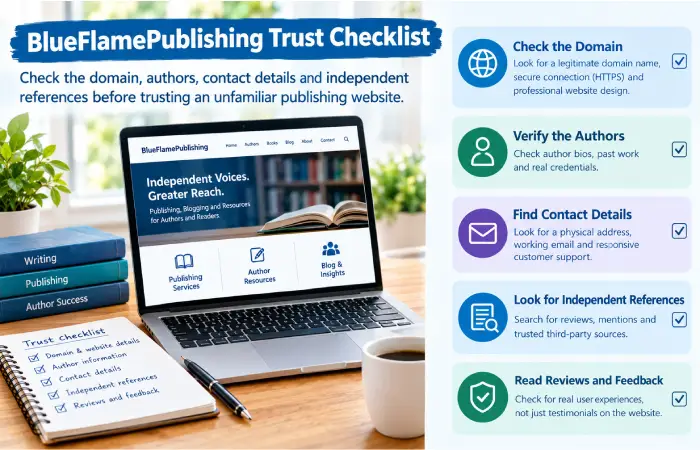
When researching post #blueflamepublishing, use this five-step process.
- Check the domain
Write down the exact domain rather than searching only for the brand name.
- Check the About page
Look for information about who operates the website and what it is intended to do.
- Check the authors
Are writers named?
Do they have relevant backgrounds?
- Verify important claims
If an article makes a strong claim, follow the cited source.
Do not assume that a claim is reliable simply because several other websites repeat it.
- Check independent sources
Look outside the website.
For publishing-related claims, useful sources can include recognised publishing organisations, academic institutions, established technology companies or industry bodies.
How Writers Can Use Publishing Posts Effectively
Publishing an article is only the first step.
A writer who wants long-term visibility should think about the entire content lifecycle.
Build topical authority
Instead of writing unrelated articles, develop a cluster.
For example:
Publishing basics
→ How digital publishing works
→ Self-publishing guide
→ Blog publishing checklist
→ Author SEO
→ Book marketing basics
→ Social media promotion for authors
This creates a stronger topical relationship between pages.
Write for people first
A common SEO mistake is trying to place the keyword everywhere.
For a keyword such as post #blueflamepublishing, repetition can quickly make the article unnatural.
Use the phrase where it genuinely helps the reader understand the topic.
Add original value
A useful article should offer something that a reader cannot obtain simply by reading another page.
That could be:
- a comparison table
- original research
- screenshots
- practical examples
- first-hand experience
- expert commentary
- a useful checklist
SEO Considerations for Post #BlueFlamePublishing
If you are creating content around this keyword, the strongest approach is likely an entity-explainer strategy.
Use the primary phrase naturally in:
- SEO title
- H1
- introduction
- one H2
- meta description
- URL
- FAQ
- conclusion
Related phrases can include:
- BlueFlamePublishing
- BlueFlamePublishing posts
- Blue Flame Publishing
- #BlueFlamePublishing
- BlueFlamePublishing blog
- posts BlueFlamePublishing
- digital publishing
- publishing platform
- author publishing
- blogging platform
Do not force all of these into every section.
Search engines increasingly need context rather than mechanical repetition.
Common Mistakes When Publishing About BlueFlamePublishing
Mistake 1: Treating every domain as official
Different websites can use similar brand names.
Always check the exact domain.
Mistake 2: Copying competing articles
If several pages make the same claim, copying them does not improve credibility.
Trace the claim to its original evidence.
Mistake 3: Overusing the hashtag
The keyword #BlueFlamePublishing should not appear in every heading.
Use it naturally.
Mistake 4: Writing only for Google
Readers should understand the article without having to decode SEO language.
Mistake 5: Making unsupported claims
Avoid statements such as “the largest”, “the most trusted”, “thousands of successful authors” or “guaranteed rankings” unless reliable evidence supports them.
Who Might Find BlueFlamePublishing-Related Content Useful?
Aspiring writers
New writers can use publishing-related articles to learn about blogging, content creation and digital visibility.
Bloggers
Bloggers may find discussions about SEO, content structure and audience development useful.
Independent authors
Indie authors need to understand both publishing and promotion.
Digital content can help establish an author’s online identity before and after publication.
Content marketers
Marketers can learn from publishing workflows and content-distribution strategies.
Readers
Readers can use publishing platforms to discover new topics, writers and perspectives.
Benefits and Limitations
No publishing platform should be evaluated only through its advantages.
Potential benefits
- Accessible digital content
- Broad range of topics
- Opportunities for writers to publish
- Easier online distribution
- Potential search visibility
- Community interaction
- Support for digital storytelling
Potential limitations
- Quality may vary between contributors
- Different websites may use similar branding
- Not every article will have the same editorial standard
- Search results can contain repetitive content
- Platform identity may be unclear
- Publishing online does not automatically create an audience
The last point is particularly important.
Publishing an article does not guarantee traffic.
SEO visibility usually requires useful content, good technical performance, appropriate search intent, internal linking, authority and time.
Post #BlueFlamePublishing and the Future of Digital Publishing
The broader publishing industry continues to move towards digital-first discovery.
Readers increasingly find writers through:
- search engines
- social media
- newsletters
- online communities
- podcasts
- video platforms
- digital magazines
- personal websites
This means an author is no longer limited to one publishing channel.
A modern publishing strategy can combine a website, long-form articles, social content, email and other media.
The challenge is maintaining quality.
Publishing more content is not automatically better. A smaller number of genuinely useful articles can create more long-term value than a large collection of repetitive pages.
Frequently Asked Questions
What is post #blueflamepublishing?
Post #blueflamepublishing is a search phrase associated with BlueFlamePublishing-related articles, blogs, digital publishing and author-focused content. Its exact meaning depends on the website or post being referenced.
Is BlueFlamePublishing a publishing company?
The name is used by websites presenting themselves around blogging, writing and digital publishing. However, readers should check the exact domain before assuming that every BlueFlamePublishing-branded website represents the same organisation.
What does #BlueFlamePublishing mean?
The hashtag can be used to identify or group online content associated with BlueFlamePublishing. It can also function as a search term for discovering related articles.
Can writers publish on BlueFlamePublishing?
Some BlueFlamePublishing-related websites describe opportunities or communities for writers and content creators. However, publishing arrangements can differ between websites, so prospective contributors should check the specific site’s current submission or contact information.
Is post #blueflamepublishing useful for SEO?
It can be useful as a long-tail entity keyword when the content genuinely addresses what people searching for the term want to know. The keyword should be used naturally rather than repeated excessively.
Is BlueFlamePublishing a blog?
BlueFlamePublishing-related websites describe themselves in terms of blogs, articles, writing and digital publishing. BlueFlamePublishing.org, for example, presents its platform as a place connecting writers and readers.
How can I check whether a BlueFlamePublishing website is authentic?
Check the exact domain, About page, contact details, authors, publishing history and independent references. Do not assume that a similar brand name means two websites are operated by the same organisation.
What type of content can be found under BlueFlamePublishing?
Search results show writing, creativity, blogging, digital publishing, technology, marketing and general-interest topics. The exact range depends on the specific BlueFlamePublishing-related website.
Final Verdict
Post #BlueFlamePublishing is best understood as an entity-related search phrase surrounding BlueFlamePublishing, online publishing, blogging and author-focused digital content.
Current search results show several different interpretations. BlueFlamePublishing.org presents itself around writers, readers, creativity and digital content, while BlueFlamePublishing.net has published pages specifically using the “Post #BlueFlamePublishing” terminology and discussing publishing, author marketing and related subjects.
Because multiple domains and third-party articles use similar terminology, readers should avoid assuming that every result belongs to one official organisation.
For SEO purposes, the strongest article is therefore one that explains the keyword clearly, discusses the different possible meanings, provides a practical verification workflow and avoids unsupported claims.
The broader lesson is useful beyond this particular keyword: when an unfamiliar brand or platform appears in search results, verify the entity before trusting the information around it.