

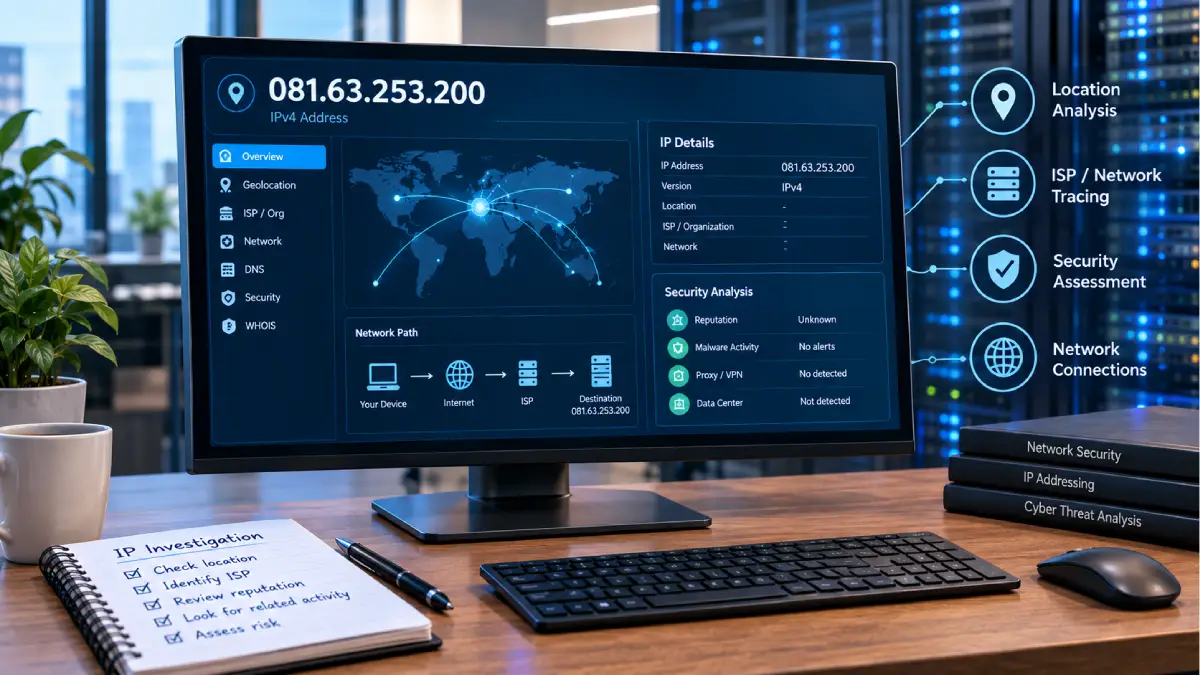
It’s very possible that you’ve stumbled upon 081.63.253.200 in a server log, security notification, network report, an email header or some other technical file. On the surface it appears to be a standard IPv4 address. There’s an important characteristic, however: the first four digits are written 081. Modern notation would show 81.63.253.200 with no leading zero.
This detail is important as some programs might process leading zero IP notation different.
It’s the purpose of this guide to let you know what this means and how you investigate and the why you should be careful in deciding whether unknown IPs is necessarily dangerous.
Table of Contents
What Is 081.63.253.200?
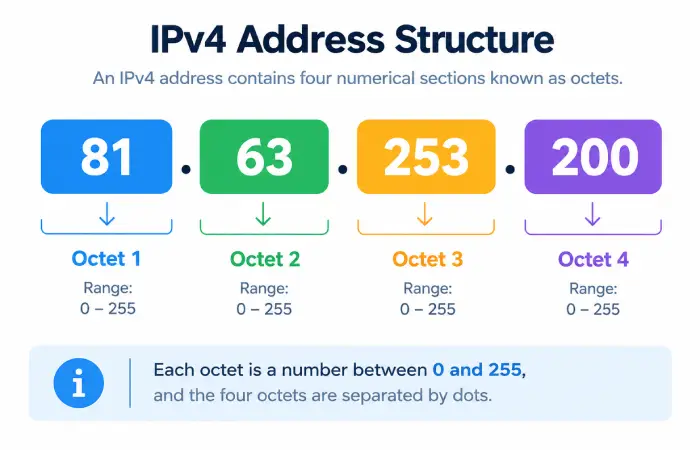
An IPv4 address consists of four numerical sections separated by full stops.
For example:
81.63.253.200
The four sections are called octets. Each octet represents a value from 0 through 255.
The address in this article is written as:
081.63.253.200
The first octet contains a leading zero. For practical investigation, it is useful to compare this with the canonical-looking form:
81.63.253.200
The difference is only the leading zero, but software and security tools may not always interpret unusual IP notation in exactly the same way.
For that reason, anyone investigating the address should avoid assuming that every system will treat both strings identically.
Why Is It Also Written as 81.63.253.200?
The first component, 081, can be represented without the leading zero as 81.
That gives:
| Original form | Normalised form |
| 081.63.253.200 | 81.63.253.200 |
Modern IP investigation tools generally work with the numerical address itself rather than treating the leading zero as meaningful.
This is particularly important when copying an address between security tools, configuration files or scripts.
A good practice is to record both forms when investigating an unfamiliar entry, while using 81.63.253.200 for standard IP lookup searches.
Is 081.63.253.200 a Valid IPv4 Address?
The numerical components are within the normal IPv4 range: 81, 63, 253 and 200 are all between 0 and 255.
However, the leading-zero notation makes the textual representation less straightforward than the conventional:
81.63.253.200
Some software has historically treated leading-zero IPv4 components differently. This can create ambiguity and, in security-sensitive situations, should not be ignored.
For this reason, it is safer to use the standard decimal representation when performing an IP lookup.
What Network Is 81.63.253.200 Associated With?
Current IP-range information places 81.63.253.200 inside the 81.63.253.0/24 range.
IPinfo currently identifies that range as belonging to AS3303, Swisscom (Switzerland) Ltd, with the broader BGP range shown as 81.63.0.0/16.
An ASN, or Autonomous System Number, identifies a network under a common routing policy on the internet.
That information can be useful when investigating an unfamiliar address.
However, there is an important limitation.
An ASN or network owner does not necessarily tell you who was personally using an IP address at a particular moment.
For example, a network operator may provide connectivity to many customers. Therefore:
Network ownership ≠ individual identity
This is one of the most important points to understand when researching an IP address.
Is 81.63.253.200 a Public or Private IP?
The address belongs to the public IPv4 address space rather than one of the commonly reserved private ranges.
Private IPv4 ranges include addresses such as:
- 10.0.0.0/8
- 172.16.0.0/12
- 192.168.0.0/16
IANA maintains the official IPv4 address-space and special-purpose registries used to distinguish globally allocated space from special-use ranges.
A public IP can be involved in internet-facing communication.
That does not, by itself, mean that the IP is malicious.
How to Check 081.63.253.200 Safely
If the address appeared in your logs, there is a sensible investigation process to follow.
1. Normalise the address
Start by checking:
081.63.253.200
against:
81.63.253.200
Use the standard representation when searching IP databases.
2. Check network ownership
Look at the IP’s:
- ASN
- Network range
- Registered organisation
- Country
- Reverse DNS information, if available
Current range information associates the relevant /24 with Swisscom’s AS3303.
3. Check reverse DNS
A reverse DNS lookup asks whether an IP address has a hostname associated with it.
Not every IP has reverse DNS.
Therefore, a missing hostname does not automatically indicate suspicious behaviour.
4. Check reputation databases
Services such as AbuseIPDB allow administrators to investigate whether an IP has been reported for abusive activity. AbuseIPDB specifically describes its service as a database for checking IP addresses associated with reported malicious behaviour.
VirusTotal also provides IP-address intelligence, including information such as ASN, country and other relationships associated with an IP.
These services should be treated as investigation tools, not as absolute proof.
5. Review your own logs
Your own logs are often more useful than a generic IP lookup.
Look for:
- Request timestamps
- Requested URLs
- HTTP methods
- Response codes
- Number of requests
- Login attempts
- Failed authentication
- User-agent information
- Repeated patterns
For example, a single ordinary page request is very different from hundreds of failed login requests within a few minutes.
Is 081.63.253.200 Dangerous?
There is not enough information in the IP address alone to say that it is dangerous.
An unfamiliar IP could represent:
- A normal internet user
- A business connection
- A mobile or broadband customer
- Automated software
- A crawler
- A security scanner
- A VPN or proxy
- Potentially malicious traffic
The behaviour associated with the address is much more useful than the number itself.
If your logs show one normal visit, there may be no reason to take action.
If the same address repeatedly attempts to access administrative pages, exploit vulnerabilities or perform large numbers of failed logins, further investigation would be reasonable.
Should You Block the IP?
Do not block an IP simply because you do not recognise it.
Blocking can make sense when there is clear evidence of unwanted activity.
Before blocking, consider:
- How frequently does the IP connect?
- What pages does it request?
- Are requests failing?
- Is it attempting authentication?
- Does the behaviour match a known attack pattern?
- Does your security system report abuse?
- Could the address belong to a legitimate customer or service?
For a website, rate limiting, authentication controls and a web application firewall can sometimes be more appropriate than permanently blocking one address. For more related articles visit our website.
Can an IP Address Reveal Someone’s Exact Location?
Generally, no.
IP geolocation databases can provide an approximate country, region or network location, but they should not be treated as a precise street-address lookup.
The result can vary between databases and can change over time.
An IP address can help identify the network or provider associated with an internet connection, but it does not automatically reveal:
- A person’s name
- Their exact home address
- Their precise physical location
- Everything they have done online
This is why IP investigations should be interpreted carefully.
What Does the ASN Tell You?
An ASN is useful because it gives additional context about the network announcing an IP range.
In this case, current IP-range information associates 81.63.253.0/24 with AS3303 / Swisscom (Switzerland) Ltd.
But an ASN should be viewed as a network-level clue.
It does not establish that Swisscom itself generated a particular request, nor does it identify the individual subscriber.
That distinction is especially important when writing security reports.
What to Do If You Found This IP in Your Website Logs
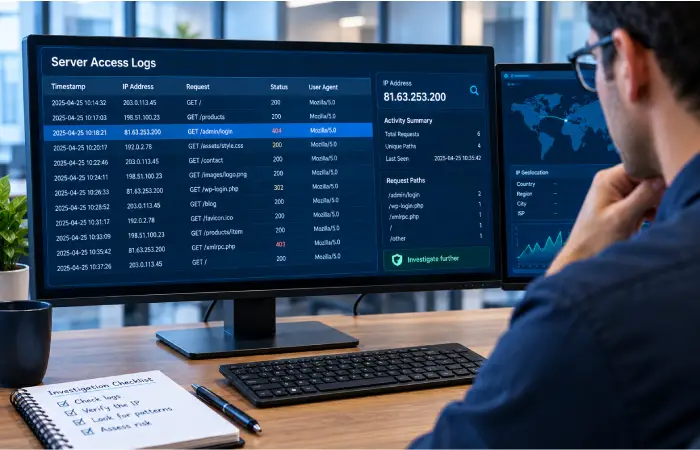
If you discovered 081.63.253.200 while checking website traffic, use this basic workflow:
Quick investigation checklist
Step 1: Convert the address to the standard form 81.63.253.200.
Step 2: Record the exact timestamp.
Step 3: Identify what page or resource was requested.
Step 4: Check whether the request was successful.
Step 5: Look for repeated requests from the same address.
Step 6: Review authentication or administrator-page activity.
Step 7: Check an IP reputation service if the activity appears suspicious.
Step 8: Compare the behaviour with other IPs making similar requests.
Step 9: Decide whether rate limiting, blocking or another security control is appropriate.
This approach is much more reliable than making a decision based on the IP address alone.
IP Address Ownership and IP Address Usage Are Different
One common mistake is to assume that the organisation associated with an IP range is the person responsible for every connection from that range.
That is not how internet addressing works.
An address may be allocated within a larger network and used by an end customer, business, device or other endpoint.
Therefore, an IP lookup should answer questions such as:
“Which network is associated with this address?”
It should not automatically be interpreted as:
“Which person owns this exact connection?”
Why IP Lookup Results Can Change
IP information is not necessarily permanent.
Networks can change:
- Routing
- Address allocations
- Reverse DNS
- Hosting arrangements
- Customer assignments
- Geolocation information
Different databases can therefore produce different results.
For serious security investigations, record when you performed the lookup and which database produced the result.
That creates a clearer audit trail.
081.63.253.200: What Should You Remember?
The most useful points are simple:
- 081.63.253.200 is an unusual representation of an IPv4-style address.
- The conventional numerical form is 81.63.253.200.
- Current range data associates 81.63.253.0/24 with AS3303, Swisscom (Switzerland) Ltd.
- Network ownership does not identify a specific person.
- An IP address alone does not prove malicious activity.
- Logs and connection behaviour provide important context.
- Reputation services can support an investigation but should not be treated as the only source of evidence.
If you found this address in a security alert or server log, investigate the surrounding activity before deciding whether it needs to be blocked.
Comparison Tables / Useful Lists
IPv4 Address Forms
| Form | Meaning |
| 081.63.253.200 | Unusual/non-canonical textual representation |
| 81.63.253.200 | Standard decimal representation to use for lookup |
| 81.63.253.0/24 | Network range containing the address |
What an IP Lookup Can Tell You
| Information | Usually, useful? |
| IP version | Yes |
| Network/ASN | Yes |
| Registered organisation | Yes |
| Approximate geolocation | Sometimes |
| Reverse DNS | Sometimes |
| Exact person | No |
| Exact home address | No |
| Proof of malicious activity | No |
FAQs
Is 081.63.253.200 a real IP address?
It resembles an IPv4 address, but the leading zero makes the written form unusual. For investigation and lookup purposes, compare it with the conventional representation 81.63.253.200.
What is 81.63.253.200?
81.63.253.200 is an IPv4 address within the 81.63.253.0/24 range. Current IP-range information associates that range with AS3303, Swisscom (Switzerland) Ltd.
Is 81.63.253.200 dangerous?
The IP address alone does not establish that it is dangerous. You should examine the behaviour associated with it, including requests, timestamps and security events.
Can I find the exact person using 81.63.253.200?
An ordinary IP lookup cannot reliably identify a specific person. It can provide network-level information, while subscriber information is generally not publicly available through a basic IP lookup.
Should I block 81.63.253.200?
Not automatically. Consider blocking or otherwise restricting an IP when your logs and security controls show a clear pattern of unwanted or abusive behaviour.
How can I check the reputation of an IP?
You can use services such as AbuseIPDB or VirusTotal to investigate available reputation and threat-intelligence information. AbuseIPDB provides IP report-history checking, while VirusTotal documents IP-address intelligence and related data.
Does an IP address show an exact location?
No. IP geolocation is generally approximate and should not be treated as a precise physical-location service.
Why does an IP appear in my website logs?
An IP can appear because a user, automated crawler, security scanner, bot or other networked system connected to your website. The surrounding request data is needed to understand what actually happened.
Conclusion
Let’s start with understanding that 081.63.253.200 is most likely 81.63.253.200. The network information that exists for it in current networks links it to AS3303 and Swisscom (Switzerland) Ltd. However, no individual person can be uniquely identified or the activity be considered a threat based on only the IP address.
If you found this IP address on your website or in your servers logs take into account the overall behaviour, time stamps and requests surrounding that IP address along with security reports related to the use of such an IP. Taking a look at ownership, DNS and IP reputation can often help.