

Table of Contents
Delage D12 – The History
Founded in 1905 by Louis Delâge, Delage became one of France’s most prestigious automotive brands. Initially focused on racing, the company later built luxurious, high-performance cars such as the D6 and D8. Its achievements in motorsport and elegant vehicle design established a strong reputation among enthusiasts and collectors.
After Delage was acquired by Delahaye in 1935, production eventually ended in 1953. In 2019, the brand was revived under the leadership of Laurent Tapie, who introduced plans for a new hybrid hypercar: the Delage D12.
The D12 was designed to combine road legality with technology and performance inspired by Formula 1 racing. Delage announced two versions: the D12 GT, intended to balance performance with road usability, and the lighter, more track-focused D12 Club.
The company also announced its ambition to challenge the Nürburgring Nordschleife lap record for a road-legal production car. The record at the time was held by the Lamborghini Aventador SVJ, which completed a lap in 6 minutes and 44.97 seconds in July 2018. The D12’s proposed record attempt was an objective rather than a confirmed achievement.
To understand how the D12 fits into the wider performance-car market, read our guide explaining what a supercar is.
What Engine Will the Delage D12 Use?
The Delage D12 was announced with a naturally aspirated 7.6-litre V12 engine paired with an electric motor. The hybrid powertrain was designed to deliver an extraordinary level of performance while incorporating some of the engineering principles associated with racing cars.
Early specifications listed approximately 1,100 horsepower for the D12 GT and around 1,010 horsepower for the D12 Club. Some reports give slightly different figures, so these numbers should be understood as announced specifications rather than independently verified production-car outputs.
Power is intended to reach the wheels through an eight-speed gearbox. The electric motor provides additional assistance, making the D12 a hybrid hypercar rather than a conventional V12-powered sports car.
The D12 Version Designed for Nürburgring Performance
Of the two planned variants, the D12 Club was presented as the more track-focused option. Although it was announced with less power than the GT, its lower weight and track-oriented setup were intended to give it an advantage on a circuit.
Delage quoted a 0–100 km/h acceleration time of approximately 2.8 seconds and a claimed top speed of up to 375 km/h. These figures reflect the company’s announced performance targets and should not be confused with independently verified test results.
The Club was developed with demanding circuit use in mind, where vehicle weight, aerodynamics, braking performance, and chassis balance can be just as important as maximum horsepower.
For readers interested in performance cars with a more accessible approach, our guide to the Suzuki Swift Sport and its key advantages explores a very different kind of sporty driving experience.
Delage D12 Weight and Lightweight Construction
Lightweight engineering is central to the Delage D12’s design. Its announced construction incorporates a carbon-fibre monocoque, while carbon-fibre components and lightweight seats help reduce overall mass.
Published specifications have listed the D12 GT at approximately 1,400 kg in dry weight, with the D12 Club reported at around 1,309 kg. Actual figures can vary depending on the specification and equipment fitted.
Reducing weight helps a high-performance car accelerate, change direction, and brake more effectively. It can also improve handling by reducing the mass that the suspension must control during demanding driving.
Delage planned a limited production run of just 30 cars, reflecting the D12’s exclusive positioning. Early reports placed the price at approximately €2 million, with some international coverage quoting around US$2.3 million. These are historical announced prices, not confirmation of current availability or transaction prices.
BST Carbon-Fibre Wheels and Exterior Design
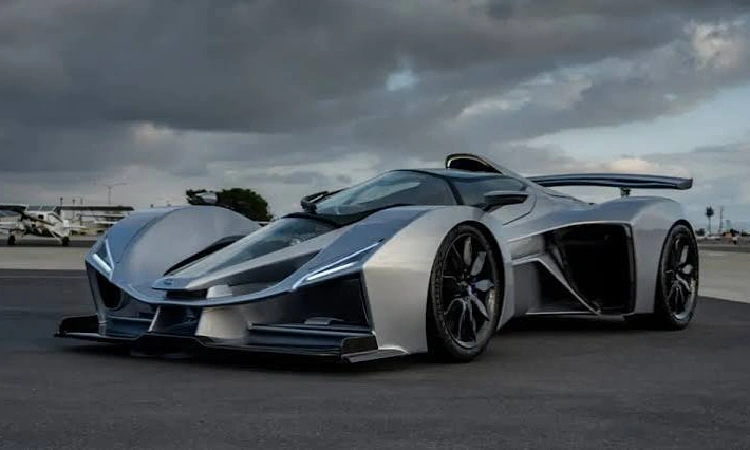
The D12’s dramatic exterior combines elements associated with Formula 1 cars and fighter aircraft. Its low body, narrow central cockpit, sculpted bodywork, and wide rear section give it a distinctive appearance that prioritises aerodynamics as well as visual impact.
A carbon-fibre monocoque forms the foundation of the structure. Carbon-fibre wheels were also presented as part of the car’s lightweight engineering approach, with a design intended to help direct cooling air towards the brakes.
The cockpit resembles a fighter-jet canopy, while a transparent panel provides a view of some of the suspension hardware. These details underline the D12’s motorsport-inspired character.
Its design is not simply about looking futuristic. Reducing weight, managing airflow, and controlling temperature are all important considerations in a car intended for high-speed circuit use.
Delage D12: A Road-Legal Hypercar with Formula 1 Inspiration
The Delage D12 was conceived to bring a racing-inspired driving experience to a road-legal vehicle. Its naturally aspirated V12 engine, hybrid assistance, carbon-fibre construction, and aerodynamic body were intended to distinguish it from traditional supercars.
The announced driving modes included City, Road, Track, and a personalised setting referred to as “My Mix.” These modes were designed to adjust the driving experience for different conditions, including electric-powered urban operation and higher-performance track driving. The precise functionality depends on the final production specification.
While the D12’s proportions and engineering have drawn comparisons with Formula 1 cars, it remains a road-car concept rather than a Formula 1 vehicle. Road legality, comfort, and usability require different compromises from those made in a purpose-built racing car.
For another perspective on performance-focused motoring, the Honda Civic Type R illustrates how a front-wheel-drive performance car can prioritise driver engagement and circuit capability in a much more conventional format.
Awards and Recognition for the Delage D12
In December 2020, the Delage D12 received the Best Design Award at the Automobile Awards 2020–2021. The jury recognised its striking styling, placing the car among the most notable automotive designs of that period.
The recognition helped draw attention to Delage’s planned return and its ambition to compete in the exclusive hypercar market. The Automobile Awards included entries from established manufacturers such as Porsche, Aston Martin, Mercedes-Benz, BMW, Audi, and Lexus.
Delage also has a distinguished history in motorsport and automotive design. Its record includes major Grand Prix achievements and recognition at concours d’elegance events, where collectors and judges celebrate vehicle design, craftsmanship, and historical significance.
The D12 therefore represents both a new engineering project and an attempt to reconnect the revived brand with its heritage of performance and exclusivity.
The Historic Legacy of Delage
Louis Delâge founded the company in 1905, beginning with small, relatively simple vehicles before expanding into more sophisticated cars. Delage quickly recognised the promotional value of racing, and its early competition successes helped establish its reputation.
The marque achieved important victories in the early twentieth century, including success in the Coupe des Voiturettes. It later became a significant Grand Prix competitor, winning the 1927 World Manufacturers’ Championship under the rules of the period.
Alongside racing, Delage developed luxurious road cars that showcased refined engineering and carefully crafted bodies. Models such as the D6 and D8 remain important examples of French automotive history.
Following its acquisition by Delahaye in 1935, Delage vehicles continued to be produced under the new ownership. The company’s manufacturing history came to an end in the early 1950s, but the name retained a following among collectors and enthusiasts.
The brand’s revival in 2019 brought that heritage back into the spotlight. The D12 was presented as a modern interpretation of Delage’s traditional combination of performance, engineering ambition, and prestige.
Conclusion
The Delage D12 is an ambitious hybrid hypercar developed to revive a historic French marque. With its announced 7.6-litre V12 engine, electric motor, carbon-fibre construction, and racing-inspired design, it aims to deliver an experience that bridges road-going performance and track-focused engineering.
Its planned production run of just 30 examples and its high announced price position it firmly in the exclusive hypercar category. However, its proposed Nürburgring record attempt and announced performance figures should be distinguished from independently verified production-car results.
Delage’s history stretches from Louis Delâge’s early racing ambitions to the luxurious cars that earned the marque its reputation. The D12 carries that legacy into a new era, illustrating how a historic automotive name can be reintroduced through modern technology and an uncompromising performance vision.