

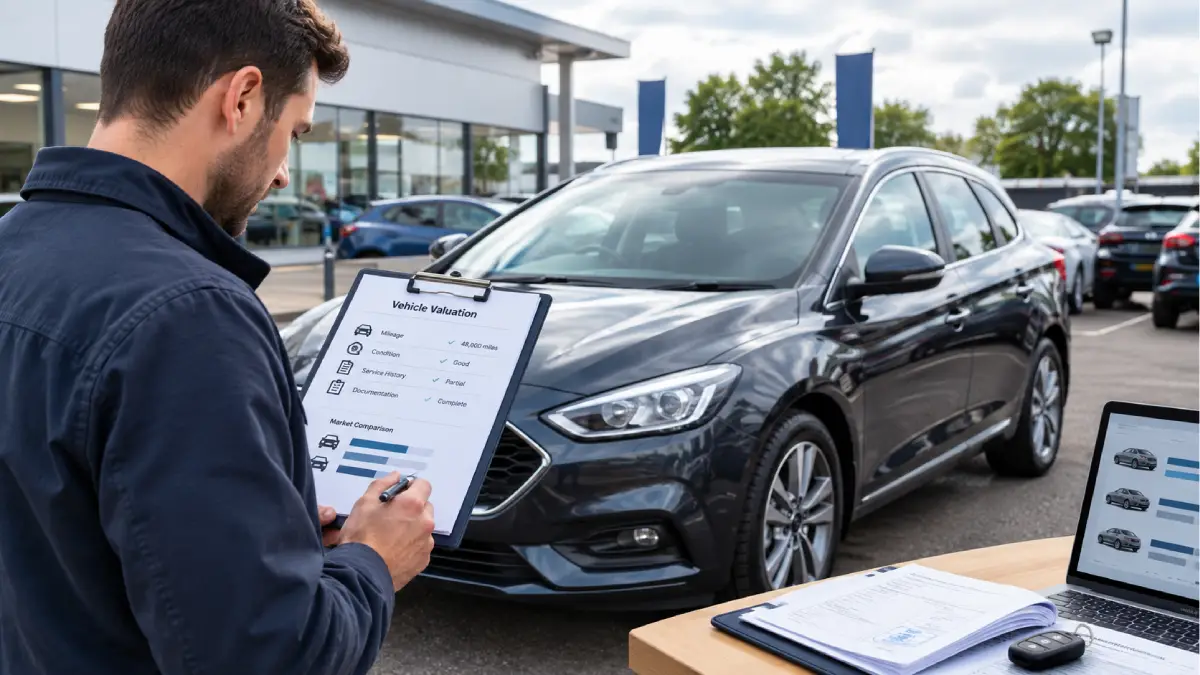
If you’re planning to replace your car, one of the first questions you may ask is “how much is my car worth trade in?” In the UK, dealers usually call this a part-exchange valuation.
The figure you receive can be different from the price you see for similar cars advertised online. That’s because a dealer has to consider the vehicle’s condition, preparation costs, market demand and the price it believes the car could eventually sell for.
The good news is that you don’t have to guess. You can check several valuations before visiting a dealer and use those figures to negotiate with greater confidence.
Table of Contents
How Much Is My Car Worth as a Trade-In?
There isn’t one fixed trade-in value for a car.
The amount a dealer offers depends on the exact vehicle and the circumstances of the deal. A valuation normally considers information such as:
- registration and exact model;
- age;
- mileage;
- engine and transmission;
- trim level;
- optional equipment;
- service history;
- MOT status;
- cosmetic and mechanical condition;
- number of previous owners;
- current market demand; and
- expected preparation costs.
Online valuation tools can give you a useful starting point. For example, Autotrader says its valuation considers age, mileage, specification and optional extras, while Motorway says its valuation uses factors including age, condition, mileage, fuel type and market demand.
However, an online valuation should normally be treated as an estimate rather than a guaranteed dealer offer.
What Is the Difference Between Trade Value, Private Value and Retail Value?
This is where many car owners get confused.
Imagine a similar car is advertised by a dealer for £12,000. That does not automatically mean a dealer will give you £12,000 for your car.
There can be several different values attached to the same vehicle.
| Type of value | What it means |
| Private-sale value | What you may realistically achieve selling directly to another person |
| Part-exchange value | What a dealer may allow against the cost of another vehicle |
| Trade value | What the vehicle may be worth within the motor trade |
| Retail value | The price a dealer may advertise the car for to customers |
A dealer buying your car has to account for what happens after you hand it over. It may need cleaning, servicing, repairs, an MOT, advertising and other preparation before the vehicle can be offered to another customer.
That is why the part-exchange figure can be below the price of similar cars advertised on dealer websites.
What Determines My Car’s Trade-In Value?
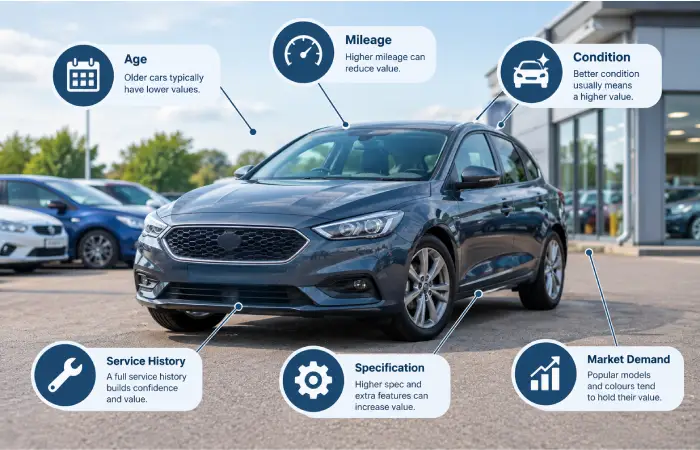
Make and model
Some cars are simply easier for dealers to sell than others.
A model with strong demand, reasonable running costs and a good reputation may attract more interest than an otherwise similar vehicle that is difficult to move from stock.
Age
Age is an important part of almost every used-car valuation.
Newer cars generally have a higher market value, while older vehicles tend to be worth less. However, age should never be considered by itself.
A well-maintained older car with sensible mileage and excellent history can still be attractive to buyers.
Mileage
Mileage gives buyers and dealers an indication of how much use a vehicle has had.
Higher mileage does not automatically make a car a bad purchase, but it can reduce its value because wear and future maintenance requirements may become more significant.
Autotrader and Carwow both identify mileage as an important factor in their valuation processes.
Condition
Condition can make a substantial difference.
A valuation based on a car being in good condition may change after an inspection reveals:
- body damage;
- worn tyres;
- damaged alloy wheels;
- warning lights;
- broken electrical equipment;
- damaged interior trim;
- dents and scratches;
- mechanical problems; or
- evidence of previous accident damage.
Be honest when completing an online valuation. If you describe a car as being in excellent condition when it has significant damage, the eventual dealer offer may be lower.
Service history and MOT
A complete service history can help demonstrate that the car has been maintained properly.
Your MOT history and supporting invoices can also give a potential buyer more confidence.
RAC recommends gathering documents such as the V5C, MOT information, service history and related bills when preparing a car for sale or part exchange.
Specification and optional extras
The exact version of a car matters.
Two vehicles with the same registration year and mileage can have different values because one might have:
- a higher trim level;
- automatic transmission;
- upgraded infotainment;
- parking cameras;
- heated seats;
- panoramic roof;
- driver-assistance technology; or
- other desirable equipment.
Make sure the valuation identifies the correct derivative rather than simply the basic model name.
Market demand
Used-car prices change according to supply and demand.
A vehicle that was easy to sell several months ago may be less desirable later. Fuel type, running costs, seasonal demand and wider market conditions can all influence what buyers are prepared to pay.
This is one reason valuations should be checked close to the time you intend to change your car.
How to Check Your Car’s Part-Exchange Value
You can get a useful estimate without immediately visiting a dealership.
1. Find your registration and current mileage
Most UK online valuation tools ask for your registration number and mileage.
This allows the system to identify the vehicle more accurately.
2. Check more than one valuation
Don’t automatically accept the first number you see.
Try several reputable valuation services and look for a realistic range rather than focusing on a single figure.
Autotrader, RAC, Carwow and Motorway all currently provide online valuation options or valuation-related services.
3. Look at comparable cars
Search for vehicles with similar:
- age;
- mileage;
- engine;
- trim;
- transmission; and
- condition.
Don’t compare your car with a much newer or better-equipped example simply because it has the same model name.
4. Assess your car honestly
Before approaching a dealer, make a list of obvious defects.
This gives you a more realistic expectation of the eventual offer.
5. Get a real dealer valuation
An online estimate isn’t necessarily the same as an actual offer.
A dealer may inspect the vehicle before confirming how much it is prepared to allow in a part-exchange deal.
Why Is My Trade-In Offer Lower Than the Advertised Price?
This is normal and doesn’t necessarily mean that the dealer is trying to undervalue your car.
Suppose you see similar cars advertised at £12,000.
A dealer might offer less because it needs to account for:
- vehicle preparation;
- repairs;
- cleaning;
- servicing;
- advertising;
- warranty costs;
- financing or stocking costs;
- market risk; and
- its expected margin.
The £12,000 advertised price is a retail asking price, not necessarily the amount the dealer would pay to acquire the vehicle.
This distinction is essential when comparing valuations.
Should I Part-Exchange or Sell My Car Privately?
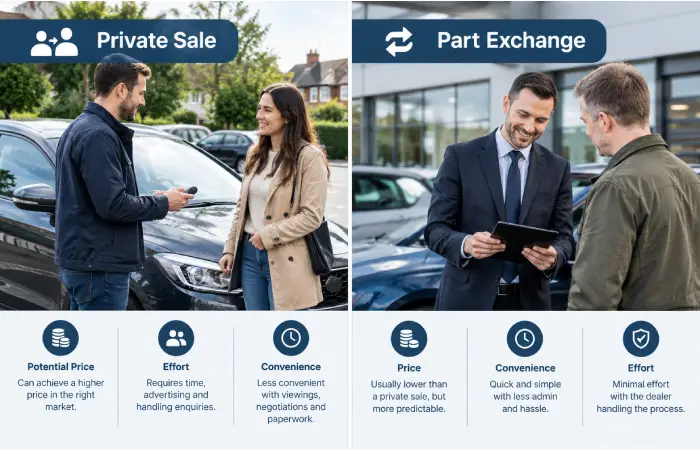
Neither option is automatically better.
Part exchange
Advantages:
- Convenient
- Less time spent advertising
- No need to arrange numerous private viewings
- The old car can form part of the new-car transaction
- Dealer handles much of the administration
Disadvantages:
- You may receive less than a successful private sale
- You have less control over the final selling price
- You need to assess the whole car-changing deal rather than just the trade-in figure
Carwow similarly notes the convenience of part exchange while explaining that selling separately may produce a higher amount.
Private sale
Advantages:
- Potentially higher selling price
- You control the advertised price
- You can negotiate directly with buyers
Disadvantages:
- More time and effort
- Enquiries and viewings
- Potentially longer selling process
- More administration
- Greater responsibility for dealing with buyers
The best choice depends on how much your time is worth and the difference between the dealer’s offer and your realistic private-sale price.
How to Get the Best Part-Exchange Price
You don’t necessarily need to spend heavily on your car before trading it in.
Instead, focus on sensible preparation.
Clean the car thoroughly
A clean interior and exterior can make the vehicle easier to inspect and present.
Gather the paperwork
Have your:
- V5C;
- service records;
- MOT information;
- receipts;
- spare keys; and
- relevant manuals
ready where applicable.
Fix inexpensive problems
Simple faults may be worth addressing if they are inexpensive to repair.
However, don’t automatically spend hundreds or thousands of pounds on repairs simply because you think they will increase the valuation.
A dealer may value the repair differently from you.
Remove personal belongings
Empty the boot, glovebox and storage compartments before inspection.
Compare offers
One dealer’s offer shouldn’t automatically be treated as the market value.
Getting more than one valuation gives you a better negotiating position.
Don’t Judge the Deal by the Trade-In Figure Alone
This is one of the biggest mistakes people make.
Imagine:
Dealer A
- New car: £20,000
- Part exchange: £8,000
- Difference: £12,000
Dealer B
- New car: £20,500
- Part exchange: £8,500
- Difference: £12,000
TheDealer B appears the offer £500 more for the car, but the amount you actually need to pay is identical.
Always compare the changeover figure, not just the part-exchange valuation.
Also compare:
- the price of the replacement vehicle;
- finance rate;
- deposit;
- fees;
- warranty;
- extras; and
- final amount payable.
What If I Still Have Finance on My Car?
If you have outstanding finance, you need to know the settlement figure before deciding how much equity you have in the vehicle.
For example:
- Car’s agreed value: £10,000
- Finance settlement: £7,000
- Remaining equity: £3,000
In this simplified example, £3,000 could potentially contribute towards your next vehicle.
But if:
- Car value: £10,000
- Finance settlement: £12,000
you have a £2,000 shortfall.
Do not assume that a part-exchange valuation automatically clears your finance. Confirm the settlement figure with your lender and understand exactly how the dealer intends to handle it.
Common Mistakes When Valuing a Trade-In
Comparing retail prices with trade offers
A dealer’s advertised price is not necessarily its purchase price.
Using only one valuation
One online calculator can give you a useful starting point, but several valuations provide more context.
Hiding damage
If an inspection discovers undisclosed damage, your final offer may change.
Spending too much on repairs
Not every repair will add its full cost back to the car’s value.
Focusing only on the part-exchange amount
The overall changeover price is often more important.
Forgetting outstanding finance
Always establish what you owe before calculating how much equity you actually have.
Comparison Tables / Useful Lists
Part Exchange vs Private Sale
| Factor | Part Exchange | Private Sale |
| Convenience | High | Lower |
| Time required | Usually lower | Usually higher |
| Potential selling price | May be lower | May be higher |
| Negotiation | Dealer | Private buyer |
| Viewings | Usually limited | Potentially numerous |
| Administration | Dealer handles much of it | Seller handles more |
| Best suited to | Convenience and speed | Maximising sale price |
Quick Car Valuation Checklist
Before requesting a valuation, have:
- Registration number
- Current mileage
- Exact model/trim
- Service history
- MOT information
- Number of keys
- Optional extras
- Known damage
- Outstanding finance informatiown
FAQs
How much is my car worth trade in?
Your trade-in or part-exchange value depends on your car’s make, model, age, mileage, condition, specification, history and current market demand. The quickest way to get an estimate is to use a reputable UK valuation tool and then obtain an actual dealer offer.
Is trade-in value the same as part-exchange value?
In the UK, they generally refer to the same basic idea: the amount a dealer allows for your existing car when you change to another vehicle.
Is part exchange worth less than selling privately?
It can be. A private sale may produce more money, but it usually requires more time and effort. A part exchange can be worthwhile when convenience and speed are more important to you.
What information do I need to value my car?
Most online tools will ask for your registration number and current mileage. A more detailed valuation may also consider condition, specification, service history and other vehicle details.
Does mileage reduce my car’s trade-in value?
Mileage is an important valuation factor. Higher mileage can reduce a car’s value because it may indicate greater wear and potentially higher future maintenance costs. However, mileage should always be considered alongside condition, history and market demand.
Should I repair my car before part exchange?
Only if the repair is reasonably priced and likely to improve the offer by enough to justify the cost. Minor presentation improvements can make sense, but expensive repairs should be considered carefully.
Can I part-exchange a car with outstanding finance?
It may be possible, but you need to know your lender’s settlement figure. Compare that figure with the vehicle’s agreed value to understand whether you have positive or negative equity.
Why are two car valuation websites giving me different prices?
Different services use different datasets, valuation models and assumptions. Some may also be estimating private-sale, dealer, retail or part-exchange values rather than exactly the same type of figure.
Conclusion
If you’re wondering how much is my car worth trade in, the most useful answer is to check several valuations rather than relying on a single figure. Your car’s part-exchange value can be affected by its age, mileage, condition, service history, specification and current demand.
Remember that a dealer’s part-exchange figure is not necessarily the same as the car’s private-sale or retail value. When comparing offers, look at the overall changeover cost, including the price of the replacement vehicle and any finance arrangements.
Before accepting an offer, check your car’s value with reputable valuation services, prepare the vehicle and paperwork, and compare more than one dealer where possible. Taking these simple steps can help you understand what your car is realistically worth and make a more informed decision about your next vehicle.