

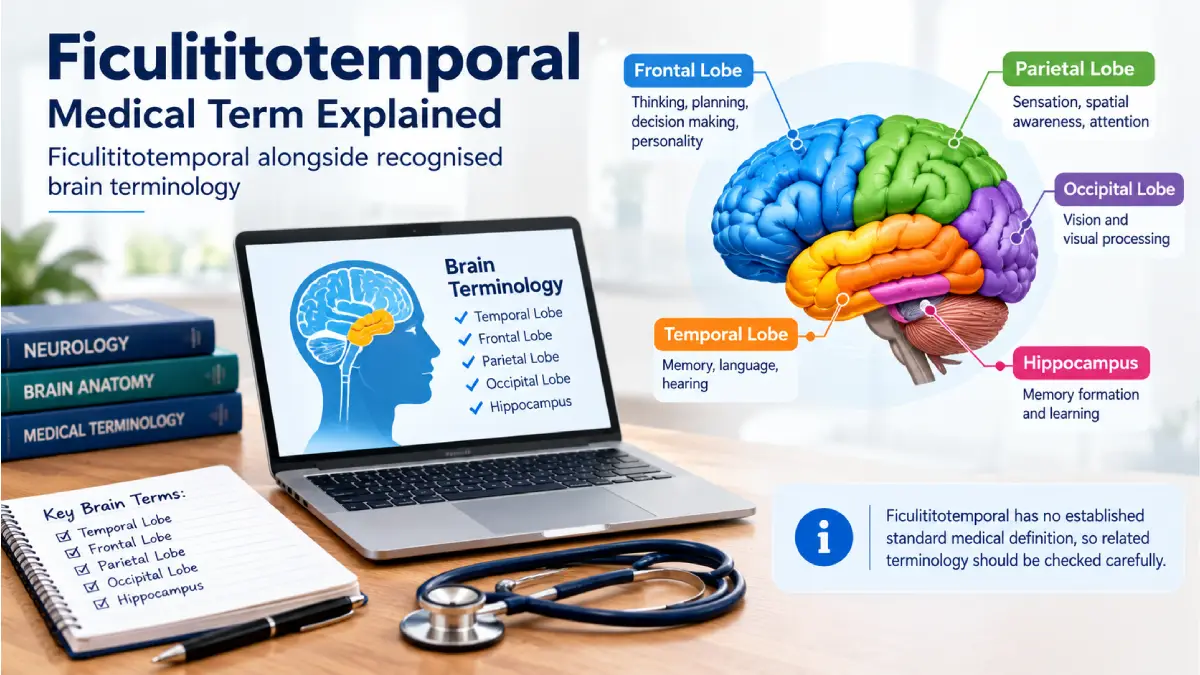
If you have searched for ficulititotemporal, you may have found websites describing it as a neurological condition, psychological concept or scientific theory. The problem is that these descriptions do not agree with one another, and the term does not have an established definition in the mainstream medical sources checked for this article.
That distinction matters. A word can look medical without actually being a medical diagnosis.
The closest legitimate terminology includes occipitotemporal, which relates to the occipital and temporal lobes of the brain, and frontotemporal, which is used in the name of a group of neurodegenerative disorders.
This guide separates the unfamiliar keyword from established medical terminology so readers can understand what is known, what is uncertain and when professional medical advice is appropriate.
Table of Contents
What Is Ficulititotemporal?
At present, ficulititotemporal is not a recognised standard medical diagnosis or established neurological term in the authoritative sources reviewed for this article.
Online pages give conflicting explanations. Some describe it as a theoretical concept, while others incorrectly associate it with frontotemporal dementia or other neurological problems. Those claims should not be treated as established medical information simply because they appear on multiple websites.
Repetition does not turn an unsupported term into a recognised diagnosis.
A more useful approach is to examine the legitimate terms that may be causing the confusion.
Is Ficulititotemporal a Medical Condition?
There is no reliable evidence that ficulititotemporal is the official name of a disease or neurological disorder.
It is important not to confuse the keyword with frontotemporal disorders, which are genuine neurological conditions affecting areas of the brain involved in behaviour, language, decision-making and other functions.
The National Institute on Aging describes frontotemporal disorders as a group of neurodegenerative diseases that primarily damage neurons in the frontal and temporal lobes.
This means that an article should not say:
“Ficulititotemporal is another name for frontotemporal dementia.”
There is not sufficient evidence to support that statement.
A better interpretation is that the unusual keyword may have been confused with established words containing frontotemporal, occipitotemporal or temporal.
Ficulititotemporal vs Occipitotemporal vs Frontotemporal
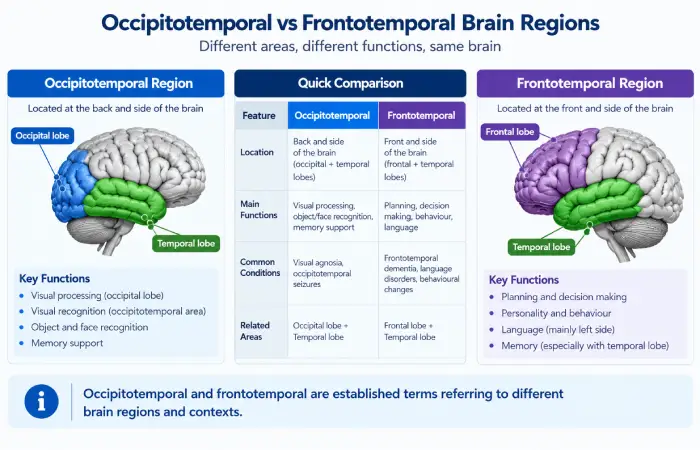
Understanding the terminology makes the issue much clearer.
| Term | What it refers to | Recognised? | Medical significance |
| Ficulititotemporal | No established standard meaning identified | No established definition | Should not be treated as a diagnosis |
| Occipitotemporal | Relating to the occipital and temporal lobes | Yes | Established anatomical terminology |
| Frontotemporal | Relating to the frontal and temporal lobes | Yes | Used in neuroanatomy and neurological disorders |
| Frontotemporal dementia | A group of neurodegenerative disorders | Yes | Recognised medical condition |
| Temporal lobe | A major region on each side of the brain | Yes | Involved in several cognitive and sensory functions |
Merriam-Webster’s medical dictionary defines occipitotemporal as relating to the occipital and temporal lobes of a cerebral hemisphere.
By contrast, frontotemporal disorders are a recognised group of conditions involving degeneration of neurons in the frontal and temporal regions.
What Does Occipitotemporal Mean?
One possible source of confusion is the word occipitotemporal.
The term combines:
- Occipital — referring to the occipital lobe
- Temporal — referring to the temporal lobe
The occipital and temporal regions participate in different but interconnected aspects of brain function.
The occipital lobe is strongly associated with visual processing, while regions extending towards the temporal lobe are involved in recognising and interpreting visual information.
The important point is that occipitotemporal is a genuine anatomical term, whereas ficulititotemporal does not have the same established status.
What Does Frontotemporal Mean?
Frontotemporal refers broadly to the frontal and temporal areas of the brain.
The frontal lobes contribute to functions such as planning, decision-making, behaviour and executive control. The temporal lobes have important roles in language, memory and recognising information.
When these regions are affected by neurodegenerative disease, doctors may use the term frontotemporal disorders.
According to the National Institute on Aging, these disorders can cause changes in behaviour, personality, communication and movement. Symptoms vary depending on which parts of the brain are affected.
Frontotemporal Dementia Is a Real Medical Condition
It is worth explaining frontotemporal dementia because several low-quality pages associate it with the unusual keyword.
Frontotemporal dementia (FTD) is a real group of neurological disorders. It primarily affects the frontal and temporal regions of the brain.
Unlike some forms of dementia where memory loss may be the most obvious early symptom, FTD can initially present with:
- Changes in personality
- Unusual or inappropriate behaviour
- Loss of empathy
- Problems with judgement
- Language difficulties
- Changes in speech
- Problems with planning
- Repetitive behaviour
- Movement difficulties in some cases
The National Institute on Aging notes that FTD often affects people at a younger age than many other dementias, with roughly 60% of people with FTD being between 45 and 64 years old.
However, these symptoms do not mean that someone has FTD. Many medical and psychological conditions can produce similar symptoms.
Symptoms Should Not Be Used to Diagnose Ficulititotemporal
One of the biggest problems with online information about unusual medical keywords is the tendency to attach a list of symptoms to an unrecognised term.
For example, if a website claims that ficulititotemporal causes memory loss, personality changes or language problems, that does not make the claim medically valid.
Symptoms such as these require proper clinical assessment.
The National Institute on Aging explains that diagnosing frontotemporal disorders can involve a medical history, neurological examination, cognitive and behavioural assessment, laboratory tests, imaging and, where appropriate, genetic testing.
A search engine cannot provide that assessment.
How Is a Genuine Frontotemporal Disorder Diagnosed?
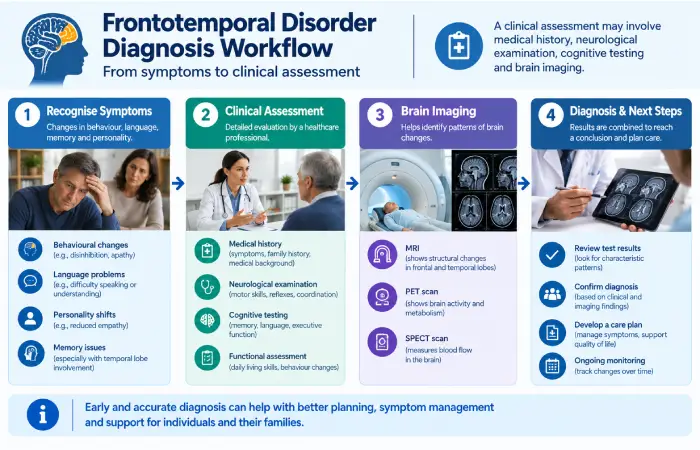
If a person has persistent changes in behaviour, communication, thinking or movement, the appropriate route is a healthcare professional rather than a search for an unfamiliar term.
Step 1: Describe the Changes
A doctor will usually want to know:
- When symptoms began
- Whether they are getting worse
- Which abilities have changed
- Whether behaviour has changed
- Whether speech or language is affected
- Whether other neurological symptoms are present
Step 2: Review Medical and Family History
Family history can be particularly relevant because some forms of frontotemporal disorder have genetic associations.
Step 3: Cognitive and Neurological Assessment
Doctors may assess thinking, language, behaviour, memory and physical or neurological function.
Step 4: Consider Brain Imaging
MRI or other imaging may be used to examine structural or functional changes and to investigate alternative explanations.
The NIA notes that MRI can show changes involving the size and shape of brain structures, although imaging can sometimes appear normal during early disease.
Step 5: Additional Testing
Depending on the circumstances, doctors may consider laboratory tests, genetic testing or other investigations.
The precise diagnostic pathway varies between individuals.
What Causes Frontotemporal Disorders?
Frontotemporal disorders are not caused by the unfamiliar term ficulititotemporal.
FTD involves neurodegenerative processes affecting neurons in specific brain regions. Researchers have identified genetic and biological factors associated with some cases, while the cause is not known for many others.
Some familial forms involve inherited genetic changes. Recognised genes associated with familial FTD include MAPT, GRN and C9orf72.
However, having a family history does not automatically mean that an individual will develop FTD.
Genetic questions should be discussed with an appropriately qualified healthcare professional or genetic counsellor. For more related articles visit our website.
Ficulititotemporal and Online Misinformation
Why does a strange term sometimes produce pages of apparently confident explanations?
Search-driven publishing can create a feedback loop.
A possible sequence is:
Unusual keyword → low-quality article → search indexing → copied article → more search results → apparent authority
The result can make an invented or poorly understood word appear established.
This is especially risky with health topics.
A reader may see five websites using the same definition and assume that five independent medical sources agree. In reality, the websites may simply be repeating one another.
A Better Verification Workflow
When you encounter an unfamiliar medical term, use this process:
Search the exact term → check medical dictionaries → check government health sources → check PubMed/medical literature → compare definitions → consult a healthcare professional if symptoms are involved
This is a much stronger workflow than relying on the number of websites using a particular definition.
How to Check Whether a Medical Term Is Legitimate
Here is a practical checklist.
1. Look for a Standard Definition
Search established medical dictionaries and terminology resources.
2. Check Government Health Organisations
Sources such as the National Institutes of Health and National Institute on Aging are useful starting points.
3. Search Scientific Literature
A genuine research concept should generally have some traceable academic literature if it is being presented as an established scientific concept.
4. Look for a Named Medical Classification
A recognised disease will generally have an established classification or diagnostic terminology.
5. Check Whether Independent Sources Agree
Don’t count copied websites as independent confirmation.
6. Ask a Professional When Symptoms Are Involved
If an unfamiliar term appeared on a medical report or was mentioned by someone involved in your healthcare, ask the relevant healthcare professional what term was intended.
What Should You Do If You Saw Ficulititotemporal on a Medical Report?
This is an important situation.
If the word appears on an actual medical document, do not assume that the document means you have a condition called ficulititotemporal.
Instead:
- Check whether the spelling was copied correctly.
- Contact the clinic or healthcare professional who issued the document.
- Ask what the term means in that specific context.
- Request the correct medical terminology if it was a transcription or spelling error.
- Follow the healthcare professional’s explanation rather than relying on unrelated websites.
A typo on a document can be surprisingly difficult to interpret without the surrounding clinical information.
What If You Are Worried About Dementia?
Searching an unfamiliar term can sometimes happen because someone has noticed changes in a family member.
If there are persistent changes in:
- Behaviour
- Personality
- Speech
- Language
- Judgement
- Planning
- Memory
- Movement
it is reasonable to discuss them with a doctor.
The National Institute on Aging recommends medical assessment because several conditions can cause cognitive or behavioural symptoms, and some causes may be treatable.
Most importantly, do not self-diagnose FTD from a list of symptoms online.
Realistic Expectations: What Can Online Research Actually Tell You?
Online research is useful for understanding terminology and preparing questions for a healthcare professional.
It cannot reliably:
- Diagnose dementia
- Determine the cause of cognitive changes
- Interpret an MRI independently
- Confirm a genetic disorder
- Predict an individual’s progression
- Replace neurological assessment
Even recognised conditions can be difficult to diagnose.
The NIA specifically notes that frontotemporal disorders can be challenging to diagnose because symptoms may resemble other conditions.
Therefore, the realistic value of an article like this is clarification, not diagnosis.
Pros and Limitations of Using Search Results to Understand the Term
Potential advantages
- Helps identify spelling errors
- Can reveal related legitimate terminology
- Makes it easier to ask informed questions
- Provides access to authoritative medical information
- Can help readers recognise unsupported claims
Limitations
- Search results can contain inaccurate health information
- Unusual keywords can generate contradictory definitions
- Repeated claims are not necessarily independent evidence
- Symptoms cannot establish a diagnosis
- Medical terminology can be easily misspelled
- AI-generated content can make unsupported definitions sound authoritative
A Simple Research Workflow for Ficulititotemporal
If you want to investigate the keyword yourself, use this sequence:
1. Search the exact spelling
Look at what different sources claim.
2. Separate established sources from generic blogs
Prioritise government health organisations, universities, medical dictionaries and peer-reviewed research.
3. Identify similar legitimate terms
In this case, occipitotemporal and frontotemporal are useful terms to investigate.
4. Check the medical literature
Search databases such as PubMed rather than relying solely on general search results.
5. Don’t convert similarity into equivalence
A similar-looking word does not necessarily have the same meaning.
6. Seek professional clarification when health is involved
Especially if the term appeared in a report or relates to symptoms.
Why Occipitotemporal and Frontotemporal Are Easy to Confuse
Medical terminology often combines anatomical regions.
For example:
- Occipito + temporal → occipitotemporal
- Fronto + temporal → frontotemporal
The suffix temporal appears in both because both terms involve the temporal lobe.
That does not mean they describe the same structure or condition.
Merriam-Webster specifically defines occipitotemporal in relation to the occipital and temporal lobes.
Frontotemporal disorders, meanwhile, primarily involve degeneration affecting the frontal and temporal regions.
This anatomical distinction is one reason careful spelling matters in medical writing.
Frequently Asked Questions
What does ficulititotemporal mean?
Ficulititotemporal does not currently have an established standard medical definition in the authoritative sources reviewed for this article. It may be an invented term, typo or confusion with another word.
Is ficulititotemporal a disease?
There is no reliable evidence establishing ficulititotemporal as a recognised disease or neurological diagnosis. It should not be used as a diagnosis without authoritative medical evidence.
Is ficulititotemporal the same as frontotemporal dementia?
No established medical source supports treating the two terms as synonymous. Frontotemporal dementia is a genuine neurological condition, while ficulititotemporal does not have the same recognised status.
Could ficulititotemporal be a spelling mistake?
Possibly. There is not enough evidence to establish its origin, but similar-looking legitimate terminology includes occipitotemporal and frontotemporal.
What is occipitotemporal?
Occipitotemporal is a recognised anatomical term describing something relating to the occipital and temporal lobes of a cerebral hemisphere.
What is frontotemporal dementia?
Frontotemporal dementia is a group of neurodegenerative disorders affecting areas of the brain primarily involving the frontal and temporal lobes. It can cause behavioural, personality, language and movement changes.
Should I be concerned if I see ficulititotemporal online?
Not because of the word itself. If it appears in a medical report or is connected with symptoms you are experiencing, ask a qualified healthcare professional to clarify what was intended.
Can a Google search diagnose frontotemporal dementia?
No. Diagnosis requires appropriate clinical assessment and may involve medical history, neurological examination, cognitive testing, imaging and other investigations.
Conclusion
Ficulititotemporal is an unusual search term without a recognised standard medical definition in the authoritative sources reviewed. It should not be presented as an established disease, neurological disorder or scientific theory simply because several websites use the word.
The most useful way to understand the keyword is to distinguish it from genuine terminology such as occipitotemporal, which refers to the occipital and temporal lobes, and frontotemporal, which is used in recognised neurological terminology.
If you encountered ficulititotemporal in a medical report, don’t try to interpret it from search results alone. Ask the healthcare professional or organisation that produced the document to confirm the intended term.
For online research, the safest rule is simple: an unfamiliar medical word needs evidence, not just a convincing-sounding definition.