


Drug and Alcohol Clearinghouse Guidance If you have a commercial driver’s license (CDL), own a trucking company, or employ commercial drivers in the United States, you’ve probably come across the Drug and Alcohol Clearinghouse.
The Clearinghouse is the system for reporting drug and alcohol programme violations and checking a driver’s status for performing safety-sensitive functions. Because some requirements vary between driver, owner-operator, industry professional, or employer, the Clearinghouse can be bewildering.
Quick definition: FMCSA Drug and Alcohol Clearinghouse The Drug and Alcohol Clearinghouse is a secure online database that gives real-time information about CDL and CLP drivers who have violated FMCSA drug and alcohol prohibitions. Employers can query the Drug and Alcohol Clearinghouse to see if existing or prospective drivers are disqualified from performing safety-sensitive duties.
Table of Contents
What Is the Drug and Alcohol Clearinghouse?
The Drug and Alcohol Clearinghouse is a secure online database operated by the Federal Motor Carrier Safety Administration (FMCSA).
It provides employers and relevant government agencies with access to information about drug and alcohol programme violations involving CDL and CLP holders covered by the FMCSA’s Drug and Alcohol Testing Programme.
The system was created to help prevent drivers with unresolved drug or alcohol violations from moving between employers without their history being identified.
The Clearinghouse can contain records involving violations of the drug and alcohol prohibitions in 49 CFR Part 382, Subpart B. Examples include qualifying positive drug or alcohol test results and test refusals. Information connected with the return-to-duty process can also be recorded.
The important point is that the Clearinghouse is not simply a general criminal background-check database. It is specifically concerned with drug and alcohol programme information covered by the applicable FMCSA rules.
Who Uses the Drug and Alcohol Clearinghouse?
The requirements depend on your role.
CDL and CLP drivers
Drivers covered by the FMCSA Drug and Alcohol Testing Programme can have information recorded in the Clearinghouse.
Drivers are not necessarily required to register simply because they hold a CDL. However, registration becomes important when they need to provide electronic consent for a full query or access their own Clearinghouse information.
A registered driver can:
- View their own Clearinghouse record
- Respond to electronic consent requests
- Provide consent for an employer’s full query
- Participate in parts of the return-to-duty process
- Identify a substance abuse professional when required
Drivers can access their own Clearinghouse records without paying a fee.
Employers
Employers subject to the FMCSA Clearinghouse requirements have responsibilities that include querying driver records and reporting qualifying violations.
A pre-employment query is required before a covered driver is permitted to perform safety-sensitive functions for the employer. Employers must also conduct queries on current drivers at least annually.
Owner-operators
Owner-operators can have a slightly different setup because they may effectively be both the employer and the driver.
An owner-operator who employs themselves as a CDL driver must meet the applicable employer requirements and designate a consortium/third-party administrator (C/TPA) to comply with the Clearinghouse reporting requirements.
C/TPAs, MROs and SAPs
Consortium/third-party administrators (C/TPAs), medical review officers (MROs) and substance abuse professionals (SAPs) can have specific responsibilities within the Clearinghouse.
For example, employers can designate a C/TPA to conduct queries or report information on their behalf. However, delegating an activity does not remove the employer’s ultimate responsibility for compliance.
What Information Does the Clearinghouse Contain?
The Clearinghouse contains information relating to covered drug and alcohol programme violations.
This can include:
- Positive DOT drug test results that meet the reporting requirements
- Qualifying alcohol test results
- Drug or alcohol test refusals
- Other reportable violations under the applicable regulations
- Return-to-duty information
- Follow-up testing information when applicable
The system is focused on information covered by the federal drug and alcohol testing rules.
For example, employers cannot simply report every drug or alcohol test performed outside DOT requirements. FMCSA states that non-DOT testing results and refusals may not be reported to the Clearinghouse.
This distinction matters because a private employer drug test that falls outside the DOT testing programme is not automatically a Clearinghouse record.
How Do Clearinghouse Queries Work?
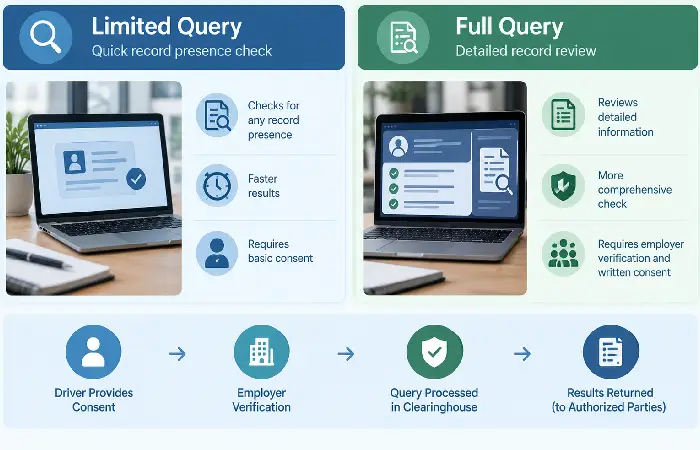
A query is an electronic check of a driver’s Clearinghouse record.
Employers use queries to determine whether a current or prospective driver is prohibited from performing safety-sensitive functions because of an unresolved drug or alcohol programme violation.
There are two main types of queries.
| Query type | Typical use | Consent |
| Limited query | Annual check of a current driver | General consent outside the Clearinghouse |
| Full query | Pre-employment check or detailed record review | Specific electronic consent in the Clearinghouse |
Full queries
A full query provides detailed information about violations in the driver’s record.
For a pre-employment query, the driver must provide specific electronic consent through the Clearinghouse.
The employer cannot simply access the driver’s detailed record without the required consent.
Limited queries
A limited query checks whether information exists in the driver’s Clearinghouse record.
It does not automatically disclose the detailed violation information.
If the limited query indicates that information exists, the employer must obtain the driver’s required electronic consent for a full query before accessing the detailed information.
When Must Employers Query the Clearinghouse?
Employers generally need to conduct:
- A pre-employment query as part of the investigation of a prospective covered driver.
- An annual query for each covered driver currently employed.
The annual requirement operates on a rolling 365-day basis. It is not simply a once-per-calendar-year requirement.
For example, if an employer performs a qualifying query on 15 September 2026, the next annual query generally needs to be completed within the applicable 365-day period.
A pre-employment query can satisfy the annual requirement for that driver for the relevant period.
Employers can use a limited query for the annual requirement, while full queries are used for pre-employment investigations and when detailed information needs to be accessed.
What Happens If a Driver Has a Violation?
A Clearinghouse violation does not necessarily mean every driver will permanently lose the ability to work.
The key question is whether the driver has an unresolved violation and therefore has a prohibited status.
A driver with an unresolved violation can be prohibited from performing covered safety-sensitive functions until the required return-to-duty process has been completed.
Employers that receive a query result showing that a driver is prohibited must remove that driver from safety-sensitive functions.
The exact steps depend on the driver’s circumstances and the applicable federal requirements.
What Does “Prohibit” Status Mean?
A prohibited Clearinghouse status means that the driver cannot legally perform covered safety-sensitive functions because of an unresolved drug and alcohol programme violation.
This is particularly important for commercial motor vehicle operations because a driver may not simply continue driving while the violation remains unresolved.
The consequences also became more significant under the Clearinghouse II rule.
Beginning on 18 November 2024, State Driver Licensing Agencies (SDLAs) were required to remove commercial driving privileges from drivers subject to a CMV driving prohibition, resulting in a CDL or CLP downgrade until the driver completes the required return-to-duty process.
Therefore, a prohibited Clearinghouse status can affect more than an employer’s internal hiring decision.
How Does the Return-to-Duty Process Work?
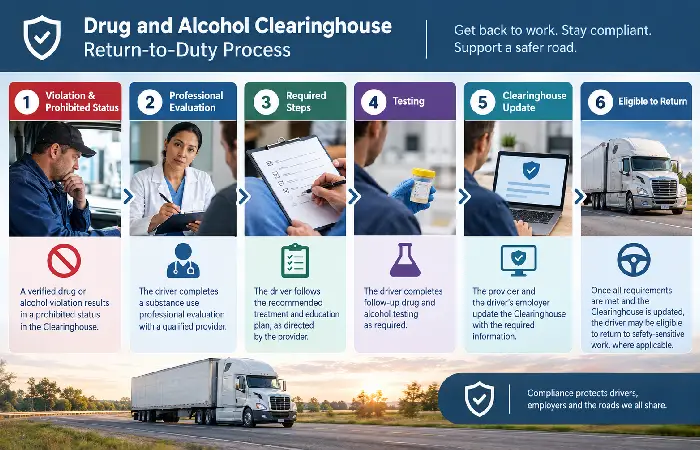
The return-to-duty (RTD) process is the process a driver must complete after a qualifying violation before returning to covered safety-sensitive work.
The process can involve:
- Working with a qualified substance abuse professional (SAP)
- Completing the required evaluation and education or treatment
- Completing the required return-to-duty test
- Completing the follow-up testing plan
- Having the required information recorded in the Clearinghouse
The precise requirements depend on the driver’s situation and applicable regulations.
Drivers should use the official FMCSA resources rather than relying on general internet advice when dealing with an active prohibited status.
FMCSA Clearinghouse resources and return-to-duty information
Can Drivers Check Their Clearinghouse Records?
Yes.
Registered drivers can access their own Clearinghouse information at no cost. A driver can see information associated with their record and, where applicable, provide consent for an employer to access detailed information.
Checking your record can be useful before applying for a driving job, particularly if you believe an old or incorrect record may affect an employer’s query.
Drivers should not assume that information is automatically removed simply because they disagree with it.
Can Incorrect Clearinghouse Information Be Corrected?
There is a process for requesting correction of inaccurate information.
However, there is an important distinction between challenging incorrectly reported information and challenging the underlying validity of a drug test result or refusal.
FMCSA states that drivers can petition to correct information in their record, but the correction process does not function as a general mechanism for disputing the validity of test results or refusals.
If you believe your Clearinghouse record is inaccurate, review the official FMCSA correction procedures carefully. For more related articles visit our website.
What Should Employers Check Before Hiring a CDL Driver?
A practical employer process can look like this:
- Confirm that the position is covered
Determine whether the driver will perform FMCSA-regulated safety-sensitive functions.
- Make sure the employer is properly registered
Employers and relevant service agents need the appropriate Clearinghouse registration.
- Obtain the required consent
A pre-employment full query requires the driver’s specific electronic consent in the Clearinghouse.
- Conduct the pre-employment query
The employer should complete the required query before allowing the driver to perform covered safety-sensitive functions.
- Review the result
If the driver is prohibited, the employer must not allow the driver to perform the relevant safety-sensitive duties.
- Track future annual queries
Current covered drivers must be queried at least annually under the applicable requirements.
- Respond to notifications
The Clearinghouse can notify an employer when new information is added to a driver’s record following a previous query. Since March 2023, notifications can cover changes occurring within 12 months of a pre-employment or annual query.
What Should Drivers Check Before Starting a New Job?
Drivers can take several practical steps:
- Make sure your personal information is accurate.
- Register for the Clearinghouse if you need access to your record or electronic consent.
- Review your record where appropriate.
- Respond promptly to employer consent requests.
- Understand whether you have a prohibited status.
- If you have a violation, follow the official return-to-duty requirements.
- Keep documentation related to your compliance process.
- Do not rely on an employer’s informal explanation when a federal requirement is involved.
The Clearinghouse gives registered drivers access to their own records, so checking your information can help you understand what an employer may encounter during the appropriate query process.
Common Drug and Alcohol Clearinghouse Mistakes to Avoid
Mistake 1: Assuming every drug test goes into the Clearinghouse
It does not.
Only qualifying DOT drug and alcohol testing information is reportable. Non-DOT test results are not automatically Clearinghouse violations.
Mistake 2: Confusing a limited query with a full query
A limited query checks whether information exists. A full query provides detailed information and requires the applicable specific electronic consent.
Mistake 3: Treating annual queries as calendar-year checks
The annual requirement is generally tracked on a rolling 365-day basis.
Mistake 4: Assuming a prohibited driver can continue driving
A prohibited driver must be removed from covered safety-sensitive functions until the applicable requirements are satisfied.
Mistake 5: Assuming registration is the same as compliance
Creating an account does not, by itself, satisfy every employer responsibility. Employers must still complete the required queries, consent processes and reporting obligations.
Mistake 6: Ignoring the owner-operator rules
Owner-operators can have both driver and employer responsibilities and may need to designate a C/TPA.
Drug and Alcohol Clearinghouse: Practical Checklist
For drivers
- Determine whether your job is covered by FMCSA requirements.
- Register if you need Clearinghouse access.
- Review your own record.
- Respond to required consent requests.
- Check whether your status is prohibited or not prohibited.
- Follow the official RTD process if applicable.
- Correct inaccurate information through the appropriate procedure.
For employers
- Register for the Clearinghouse.
- Identify all covered CDL/CLP drivers.
- Complete required pre-employment queries.
- Obtain the correct type of driver consent.
- Conduct annual queries.
- Monitor relevant Clearinghouse notifications.
- Report qualifying violations as required.
- Remove prohibited drivers from covered safety-sensitive functions.
- Use official FMCSA guidance when requirements are unclear.
Is the Drug and Alcohol Clearinghouse the Same as a Standard Background Check?
No.
A standard employment background check may cover areas such as criminal records, employment history or driving history, depending on the service used.
The Drug and Alcohol Clearinghouse has a more specific purpose: it provides information about covered drug and alcohol programme violations associated with CDL and CLP holders.
For employers, the Clearinghouse is therefore one part of the broader driver investigation and compliance process rather than a universal replacement for every background check.
Is the Clearinghouse Information Private?
Access to detailed driver violation information is controlled.
FMCSA states that detailed drug and alcohol violation information is shared with a current or prospective employer, and/or its designated C/TPA, when the required specific driver consent has been obtained. Drivers can see the information that would be released before providing consent.
This is one reason drivers should keep their account information accurate and respond carefully to consent requests.
What Has Changed in Recent Years?
The Clearinghouse has evolved since its introduction.
One important development was the expansion of the system to contain three years of violation data. From 6 January 2023, the Clearinghouse could satisfy the applicable inquiry requirement for previous FMCSA-regulated employers when a prospective employer conducted the required pre-employment query.
Another significant change came with Clearinghouse II. From 18 November 2024, a prohibited status results in the removal or denial of commercial driving privileges through the applicable state licensing process until the driver completes the RTD process.
There have also been more recent security changes. FMCSA states that, beginning 27 April 2026, certain new Clearinghouse users must complete identity verification during registration, including specified employers, C/TPAs, MROs, SAPs and assistants.
Because federal requirements can change, drivers and employers should check the current FMCSA Clearinghouse resources when making compliance decisions.
Comparison Tables / Useful Lists
Limited vs Full Clearinghouse Queries
| Feature | Limited Query | Full Query |
| Main purpose | Check whether information exists | Obtain detailed information |
| Common use | Annual query | Pre-employment query |
| Detailed violation information | No | Yes |
| Driver consent | General consent outside Clearinghouse | Specific electronic consent in Clearinghouse |
| Can identify whether records exist? | Yes | Yes |
| Employer use | Current drivers | Prospective drivers and detailed follow-up checks |
FMCSA confirms that limited queries can satisfy the annual query requirement, while full queries include pre-employment queries.
Driver vs Employer Responsibilities
| Driver | Employer |
| Access own record | Register for Clearinghouse |
| Provide required consent | Conduct required queries |
| Respond to query requests | Report qualifying violations |
| Follow RTD requirements when applicable | Remove prohibited drivers from covered duties |
| Request correction of inaccurate information | Conduct required annual queries |
| Keep account information current | Respond to relevant notifications |
FAQ’s
- What is the Drug and Alcohol Clearinghouse?
It is an FMCSA secure online database containing information about qualifying drug and alcohol programme violations involving covered CDL and CLP holders.
- Do all CDL drivers have to register for the Clearinghouse?
Not necessarily. Drivers need to register when they need to access their own records or provide electronic consent for a full query, among other situations.
- How often must employers check the Clearinghouse?
Employers must conduct a pre-employment query for covered prospective drivers and queries on current covered drivers at least annually. The annual requirement operates on a rolling 365-day basis.
- What is a full Clearinghouse query?
A full query allows an employer or designated C/TPA to access detailed information about violations in a driver’s Clearinghouse record, subject to the required driver consent.
- What happens if a driver is prohibited in the Clearinghouse?
The driver cannot perform covered safety-sensitive functions until the applicable violation and return-to-duty requirements have been resolved. A prohibited status can also result in the loss or denial of CDL or CLP commercial driving privileges under Clearinghouse II.
- Can drivers see their Clearinghouse records?
Yes. Registered drivers can access their own records at no cost.
- Can incorrect Clearinghouse information be corrected?
Yes. Drivers can use the applicable FMCSA correction process to request correction of inaccurate information, although the process does not generally allow drivers to challenge the validity of test results or refusals themselves.
- Does every drug or alcohol test appear in the Clearinghouse?
No. FMCSA states that only DOT drug or alcohol tests and refusals that fall under the applicable requirements can be reported. Non-DOT testing results are not reportable to the Clearinghouse.
Conclusion
The Drug and Alcohol Clearinghouse is an important part of the FMCSA’s drug and alcohol compliance system for covered commercial drivers. It gives employers and government agencies a central source of information about qualifying drug and alcohol programme violations and helps identify drivers who may be prohibited from performing safety-sensitive functions.
For drivers, the most important steps are understanding their Clearinghouse record, responding to required consent requests and following the proper return-to-duty process if a violation results in prohibited status.
For employers, compliance means more than simply creating a Clearinghouse account. Employers need to complete the required pre-employment and annual queries, obtain the appropriate consent, respond to relevant notifications and take action when a driver is prohibited.
Because the rules are regulatory and can change, the safest approach is to use the official FMCSA Clearinghouse resources for current requirements rather than relying on outdated summaries or informal advice.