

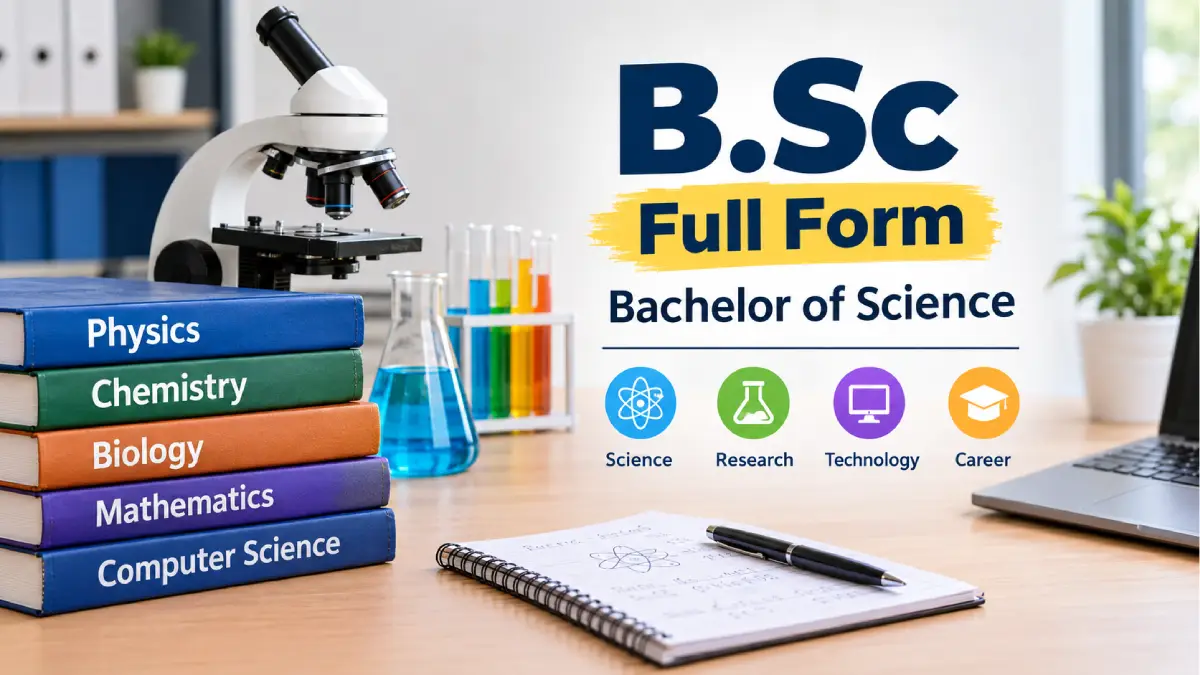
- Sc Full form is Bachelor of Science. It’s an undergraduate degree that emphasizes upon subjects based around sciences, Mathematics or Engineering, applied science technology or further academic discipline. Subjects depending upon university and speciality; includes subjects of Chemistry, Biology, Physics, Mathematics, Information Technology, Computer Science, and Biotechnology and Environmental science and more.
Table of Contents
What Is the B.Sc Full Form?
The B.Sc full form is Bachelor of Science.
These degrees are also awarded to the undergraduates basically for this science world and its companions… The various streams of streams are manifold as anyone can make their own choice regarding subjects as per will and wish.
A B. Sc degree is a single and a wide heading of degree programs and a student may study more than just one subjects… For an example: if another B. Sc is an Honors in Physics a one could B. Sc in zoology, a B. Sc in maths, a B. Sc in Computers etc.
The regulations regarding study curriculum, minimum requirements of eligibility for admission, duration of study and the examination procedures may differ significantly based on your choice of institution and university as countries widely differ from each other regarding all the above rules hence students should also follow the norms laid by the respective countries institution.
The B. Sc degree is quite often thought as the required and useful graduation for a students interested in the science subjects for higher studies in the similar fields, research work, teaching or in some fields of science and technology-based careers.
B.Sc Full Form in Simple Words
In simple terms:
B = Bachelor
Sc = Science
So, B.Sc means Bachelor of Science.
It is normally an undergraduate qualification completed after higher secondary education or an equivalent qualification.
The degree can involve theoretical learning, practical laboratory work, assignments, projects and examinations. The balance between these activities depends on the specialisation.
To make it concrete a Physics or Chemistry student would have a large amount of laboratory work whereas a Maths student would work more on solving problems and concepts.
What Does a B.Sc Course Involve?
A B.Sc course generally combines subject knowledge with analytical and practical skills.
The experience can be quite different from one specialisation to another.
A typical science degree may include:
- Classroom lectures
- Laboratory practicals
- Tutorials
- Assignments
- Internal assessments
- Examinations
- Practical examinations
- Projects
- Presentations
- Independent study
Some programmes are highly theoretical, while others place greater emphasis on experiments, computing or fieldwork.
For example, a B.Sc Biology programme may involve laboratory experiments and biological observation, whereas B.Sc Mathematics may concentrate heavily on mathematical reasoning and proof.
This is why choosing the specialisation is often more important than simply choosing a B.Sc degree.
Common B.Sc Specialisations
There are many B.Sc subjects available across universities.
Some common options include:
| B.Sc specialisation | Main area of study | Possible career direction |
| B.Sc Physics | Matter, energy and physical laws | Research, education, technical roles |
| B.Sc Chemistry | Chemicals, reactions and materials | Laboratories, research, industry |
| B.Sc Mathematics | Mathematical theory and applications | Data, finance, education, analytics |
| B.Sc Biology | Living organisms and biological systems | Research, laboratories, education |
| B.Sc Computer Science | Computing, programming and systems | Software, IT, data-related roles |
| B.Sc Biotechnology | Biology and technology | Biotechnology, laboratory research |
| B.Sc Zoology | Animals and biological sciences | Research, education, environmental work |
| B.Sc Botany | Plants and plant sciences | Agriculture, research, education |
| B.Sc Statistics | Data, probability and statistical analysis | Analytics, research, finance |
| B.Sc Environmental Science | Environment and sustainability | Environmental monitoring, research |
| B.Sc Microbiology | Microorganisms and laboratory science | Laboratories, research, healthcare-related industries |
The availability of these programmes varies by institution.
B.Sc Course Duration
The duration of a B.Sc depends on the country, university and programme structure.
In India, many undergraduate science programmes have traditionally been structured as three-year degrees, although four-year undergraduate programmes are also available under newer higher-education frameworks and at particular institutions.
Students should therefore avoid assuming that every B.Sc course has exactly the same duration.
A university may offer:
- A three-year undergraduate programme
- A four-year undergraduate programme
- Honours or research-oriented pathways
- Integrated programmes
The safest approach is to check the current prospectus of the university before applying.
B.Sc Eligibility Requirements
Eligibility requirements vary according to the institution and specialisation.
For many science degree programmes in India, students are expected to have completed Class 12 or an equivalent qualification.
Some programmes may require particular subjects.
For example:
- Physics programmes may require Physics and Mathematics.
- Chemistry programmes may have science-subject requirements.
- Biology-related programmes may require Biology.
- Computer Science programmes may require Mathematics or another specified subject.
- Some interdisciplinary programmes may have broader eligibility criteria.
Minimum marks can also differ between institutions.
Admission may be based on Class 12 results, an entrance examination, merit lists or another selection process.
Important point
Do not assume that qualifying for one B.Sc course automatically makes you eligible for every other B.Sc specialisation.
Always check:
- Required Class 12 subjects
- Minimum marks
- Entrance examination requirements
- Age rules, where applicable
- University-specific conditions
- Reservation or category requirements where relevant
- Application deadlines
B.Sc Admission Process: Step-by-Step Workflow
The admission process differs between institutions, but a typical workflow looks like this:
Choose specialisation → Shortlist universities → Check eligibility → Check admission method → Apply → Take entrance test if required → Review merit/selection result → Complete admission formalities
Step 1: Choose a subject
Think about the science subject you enjoy and the type of work you may want to pursue later.
Step 2: Research universities
Compare curriculum, facilities, faculty, location, fees and admission requirements.
Step 3: Check eligibility
Make sure your Class 12 subjects and marks satisfy the programme requirements.
Step 4: Complete the application
Submit the application form and required documents within the stated deadline.
Step 5: Complete selection requirements
Some universities may use entrance examinations, while others may use merit-based admission.
Step 6: Confirm your place
If selected, complete the institution’s admission and fee-payment process according to its instructions.
B.Sc Subjects: What Will You Study?
The subjects depend heavily on your specialisation.
A Physics student might study mechanics, electromagnetism, thermodynamics and mathematical methods.
A Chemistry student may study organic, inorganic and physical chemistry.
A Computer Science student could study programming, algorithms, databases, computer networks and operating systems.
A Mathematics student might study calculus, algebra, statistics, differential equations and other mathematical areas.
Example subject structure
| Specialisation | Examples of subjects |
| Physics | Mechanics, optics, thermodynamics, electromagnetism |
| Chemistry | Organic, inorganic and physical chemistry |
| Mathematics | Calculus, algebra, statistics, differential equations |
| Computer Science | Programming, algorithms, databases, networks |
| Biology | Cell biology, genetics, ecology, physiology |
| Biotechnology | Molecular biology, genetics, microbiology, biochemistry |
| Statistics | Probability, statistical methods, data analysis |
| Environmental Science | Ecology, conservation, pollution, environmental management |
These are examples rather than a universal syllabus.
Skills You Can Develop During a B.Sc
A good science degree is not only about passing examinations.
Students can develop transferable skills that may remain useful after graduation.
Analytical thinking
Science subjects require students to interpret information, identify relationships and solve problems.
Research skills
Laboratory work and academic projects can introduce students to research methods, data collection and evidence evaluation.
Quantitative skills
Mathematics, statistics and many scientific subjects involve numerical analysis.
Technical skills
Depending on the course, students may learn programming, laboratory techniques, statistical software or scientific instruments.
Communication
Reports, presentations and group assignments can help develop written and verbal communication.
Problem-solving
Science education often requires students to approach unfamiliar problems systematically.
These skills can be useful in both science-related and broader careers.
B.Sc vs Other Undergraduate Degrees
Students sometimes confuse B.Sc with degrees such as B.A. and B.Com.
The primary difference is the academic focus.
| Degree | Full form | Broad focus | Typical subjects |
| B.Sc | Bachelor of Science | Science and related disciplines | Physics, chemistry, biology, maths, computing |
| B.A. | Bachelor of Arts | Humanities, arts and social sciences | History, languages, sociology, psychology |
| B.Com | Bachelor of Commerce | Commerce and business | Accounting, finance, economics, business |
| B.Tech | Bachelor of Technology | Engineering and technology | Engineering, computing, electronics, mechanical subjects |
These categories are broad. Modern university programmes can overlap considerably.
For example, data science may involve mathematics, statistics and computing, while biotechnology combines biology with technology.
B.Sc vs B.Tech: Which Is Better?
There is no universal answer.
The better option depends on the student’s interests and career plans.
A B.Sc is generally more science-focused and can be a good foundation for postgraduate science education, research and science-related careers.
A B.Tech is generally structured around engineering and applied technology.
For example, a student interested in theoretical mathematics might prefer B.Sc Mathematics, while someone interested in engineering systems may prefer an engineering degree.
Simple comparison
| Factor | B.Sc | B.Tech |
| Main focus | Science | Engineering and technology |
| Approach | Scientific and analytical | Applied and engineering-oriented |
| Laboratory work | Depends on subject | Common in many programmes |
| Mathematics | Depends on specialisation | Often substantial |
| Programming | Common in computing-related B.Sc courses | Common in many technology courses |
| Higher study | M.Sc, research and other postgraduate routes | M.Tech, M.E., MBA and other routes |
| Career direction | Depends strongly on specialisation | Often engineering/technology focused |
Neither degree automatically guarantees a particular career.
Career Options After B.Sc

Career opportunities depend heavily on the specialisation, practical skills, postgraduate qualifications and work experience.
Possible directions include:
- Laboratory work
- Research assistance
- Data analysis
- Software and IT roles
- Quality control
- Technical support
- Environmental work
- Education
- Scientific sales
- Healthcare-related laboratory roles
- Pharmaceutical industry roles
- Biotechnology
- Agriculture-related industries
- Government and public-sector opportunities
Some careers require additional qualifications.
For example, a graduate who wants to become a university researcher will generally need postgraduate study and, depending on the career path, further research qualifications.
Similarly, professional roles regulated by law may have specific licensing or educational requirements.
What Can You Do After B.Sc?
Graduation does not necessarily mean you have to enter full-time employment immediately.
Several pathways are available.
Option 1: Start working
Students with appropriate skills may seek entry-level positions related to their specialisation.
Option 2: Study an M.Sc
An M.Sc can provide deeper knowledge in a specific scientific field.
For students interested in research or specialist scientific careers, postgraduate study can be an important next step.
Option 3: Move into data and technology
Students from mathematics, statistics, computer science and related disciplines may develop additional technical skills for data, analytics or software-related careers.
Option 4: Prepare for competitive examinations
Some graduates choose government, public-sector or other competitive examinations, depending on the eligibility requirements.
Option 5: Professional courses
Additional qualifications in areas such as management, computing, education or other fields may broaden career options.
Salary Expectations After B.Sc
There is no single salary figure for B.Sc graduates.
Pay depends on:
- Specialisation
- Employer
- Location
- Technical skills
- Experience
- Industry
- Additional qualifications
- Job responsibilities
A fresh graduate may start at an entry-level salary, while someone with several years of experience and specialised skills can potentially earn considerably more.
It is better to avoid choosing a B.Sc course based solely on advertised salary figures.
A more useful approach is to investigate the career path itself.
Ask:
What jobs does this degree commonly lead to?
What additional skills are required?
Does the career require postgraduate education?
What is the long-term demand for these skills?
This provides a more realistic picture than relying on a single salary estimate.
Advantages of Studying B.Sc
A B.Sc can offer several benefits.
Broad choice of specialisations
Students can study traditional sciences as well as computing, biotechnology, statistics and interdisciplinary subjects.
Foundation for postgraduate study
Many B.Sc programmes provide a foundation for M.Sc and other advanced qualifications.
Development of analytical skills
Science education encourages logical reasoning, quantitative thinking and evidence-based problem-solving.
Research exposure
Laboratory and project work can introduce students to scientific research.
Flexible career direction
Depending on the specialisation, graduates can enter scientific, technical, analytical, educational or business-related roles.
Limitations and Challenges of B.Sc
A balanced view is important.
The degree alone may not be enough
Some competitive careers require postgraduate qualifications or additional professional training.
Career outcomes vary by subject
A B.Sc Computer Science graduate and a B.Sc Botany graduate may have very different career opportunities.
Practical skills matter
Employers may look for technical skills and experience in addition to a degree certificate.
Further study can be important
Students interested in research, specialist scientific roles or academic careers may need to continue their education.
Course quality varies
The name of the degree does not tell you everything. Curriculum, teaching quality, laboratory facilities and practical exposure can differ significantly between institutions. For more related articles visit our website.
How to Choose the Right B.Sc Specialisation
Choosing a subject is an important decision, but it does not need to be based on trends alone.
Use this simple framework:
1. Consider your strongest subjects
Which subjects did you genuinely enjoy at school?
2. Think about the type of work you like
Would you prefer laboratory work, computers, mathematics, fieldwork or theoretical study?
3. Check the curriculum
Look at the actual subjects taught rather than relying only on the course name.
4. Research careers
Find out what graduates typically do after completing the degree.
5. Check postgraduate requirements
Some career paths require an M.Sc or other advanced qualification.
6. Compare institutions
Consider accreditation, facilities, faculty, fees and placement information where applicable.
Is B.Sc a Good Degree?
B.Sc can be a good undergraduate choice for students who are interested in science, mathematics, computing or related subjects.
However, the value of the degree depends heavily on what you study and what you do with it.
A student who combines a B.Sc with strong technical skills, practical experience, internships, projects or postgraduate education may have a wider range of opportunities than someone who relies only on the degree certificate.
There is also no requirement to have your entire career planned at the age of 17 or 18.
An undergraduate degree can provide a foundation from which you later specialise.
Common Mistakes Students Make When Choosing B.Sc
Choosing a course only because friends selected it
Your interests and strengths may be completely different.
Focusing only on salary
Starting salaries can change by industry and location. Look at long-term career development instead.
Ignoring the syllabus
Two B.Sc programmes with similar names can have noticeably different curricula.
Assuming every B.Sc is the same
Specialisation matters enormously.
Not checking eligibility
A particular programme may require specific Class 12 subjects.
Ignoring practical experience
Projects, internships and technical skills can make a significant difference when looking for employment.
Frequently Asked Questions
What is the B.Sc full form?
The B.Sc full form is Bachelor of Science. It is an undergraduate degree covering science and related academic disciplines.
What does B.Sc stand for?
B.Sc stands for Bachelor of Science.
Is B.Sc a graduation degree?
Yes. B.Sc is an undergraduate or bachelor’s degree.
How many years is a B.Sc course?
The duration depends on the university and programme. In India, many B.Sc programmes have traditionally been three years, while four-year undergraduate structures are also available at some institutions.
What subjects can I study in B.Sc?
Options can include Physics, Chemistry, Mathematics, Biology, Computer Science, Biotechnology, Statistics, Zoology, Botany and Environmental Science, depending on the university.
Can I do an M.Sc after B.Sc?
Yes, many B.Sc graduates progress to an M.Sc in a relevant or related subject, subject to the institution’s eligibility requirements.
Is B.Sc better than B.Tech?
Neither is universally better. B.Sc is generally more science-focused, while B.Tech is more engineering and technology-oriented. The right choice depends on your interests and career plans.
Can I get a job after B.Sc?
Yes. Career opportunities depend on the specialisation, skills, experience and employer. Some career paths may require additional qualifications.
Is B.Sc good for research?
It can provide a foundation for research, particularly when followed by postgraduate study and further research training.
Which B.Sc course is best?
There is no single best B.Sc course for everyone. Computer Science, Mathematics, Physics, Chemistry, Biology, Biotechnology, Statistics and other fields can all be useful, depending on the student’s interests and career goals.
Final Thoughts
The B.Sc full form is Bachelor of Science, but the term represents much more than one specific course. It covers a broad family of undergraduate programmes ranging from Physics and Chemistry to Computer Science, Mathematics, Biotechnology and other scientific disciplines.
The most important decision is not simply whether to study B.Sc. It is which specialisation, university and career pathway fit your goals.
Students should compare eligibility requirements, curriculum, practical opportunities, fees, postgraduate pathways and career options before making a decision. A B.Sc can provide a strong academic foundation, but realistic career planning usually requires more than the degree name alone.
If you are considering B.Sc, start by identifying the subjects you enjoy, researching the careers connected with them and checking the current requirements of universities you are interested in.