

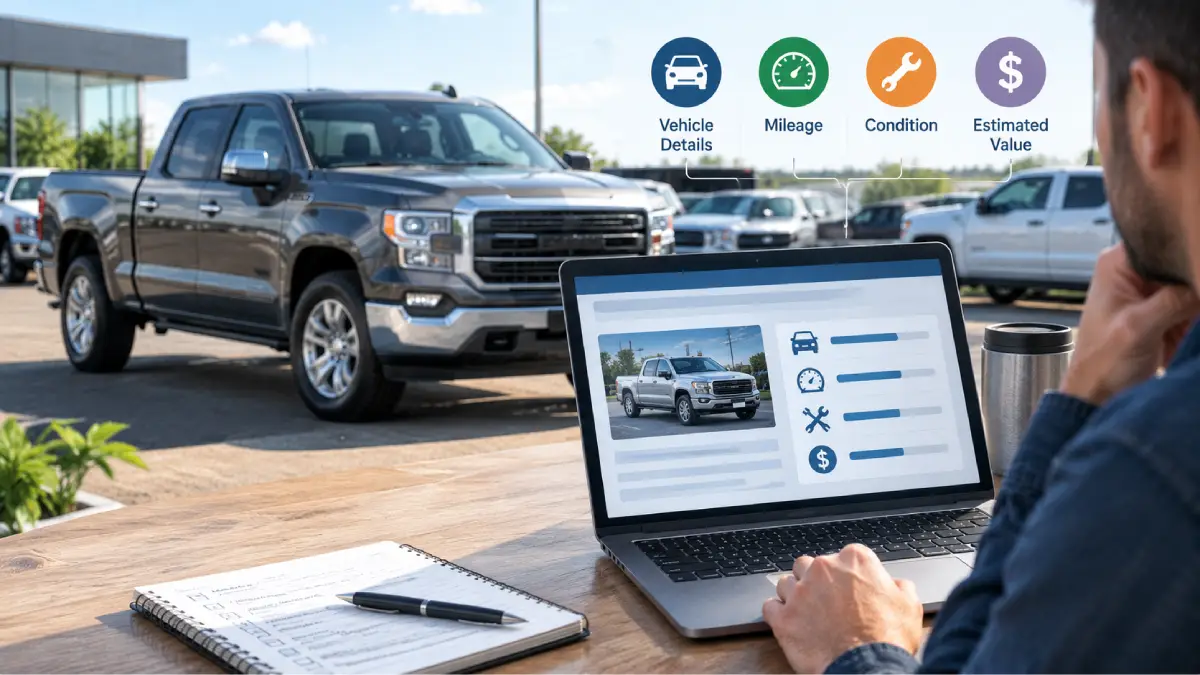
You are here if you view Kelley Blue Book Trucks Used Value and you probably are asking yourself a pretty straight forward question: How much is this used truck worth? It is not always quite that simple.
Kelley Blue Book (KBB) has a number of different values – the trade-in value when you trade a truck into a dealer, the value for if you sell it to a private buyer and the value if you buy one from a dealer. KBB factors in mileage, equipment, local market conditions and vehicle specifications.
That makes KBB useful as a starting point, but it should be used alongside the truck’s history, condition and current local listings.
Table of Contents
What Does Kelley Blue Book Trucks Used Value Mean?
The phrase Kelley Blue Book trucks used value generally refers to the estimated market value of a used pickup or truck shown through KBB’s vehicle valuation tools.
There is not necessarily one value for every truck.
For example, the amount you might receive by trading a truck to a dealer can be different from the amount you might reasonably ask when selling it to another individual. Similarly, the price a dealer advertises for a used truck is not necessarily the same as the amount a buyer should expect to pay.
KBB currently provides several types of used-vehicle pricing information, including Trade-In Value, Private Party Value, Fair Purchase Price and Fair Market Range.
The first step is therefore to decide what you are trying to do with the truck.
How Kelley Blue Book Determines a Used Truck’s Value
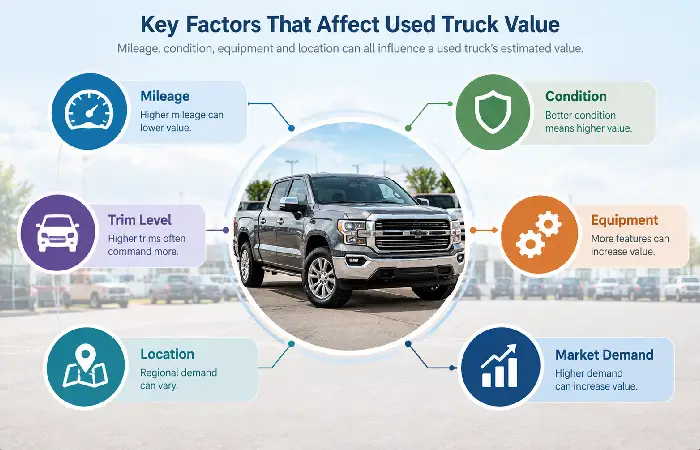
KBB uses large amounts of market data and adjusts its valuations for factors including local conditions and market trends. Its consumer information says values are updated or verified at least weekly, although an update does not necessarily mean every vehicle’s value changes.
Year, Make and Model
The truck’s basic identity establishes the starting point for its valuation.
A 2022 Ford F-150, for example, should not be valued in the same way as a 2015 F-150. Even trucks from the same model year can have significantly different values depending on configuration.
The exact model, body style and trim therefore matter.
Mileage
Mileage is another important factor.
KBB analyses transaction data to determine typical mileage for vehicles of different ages. Vehicles with mileage above or below the expected level can receive corresponding adjustments.
When checking a used truck, record the exact odometer reading rather than estimating it.
A truck with 65,000 miles and an otherwise identical truck with 125,000 miles should not be expected to have the same valuation.
Condition
The condition can make a big difference. KBB prompts you to pick from categories like excellent, good, fair, poor. It reminds you that you may rate your own car more favorably than it really is.
Be realistic when assessing:
- Paint and bodywork
- Interior condition
- Tyres
- Mechanical operation
- Warning lights
- Glass
- Suspension
- Previous repairs
- General wear and tear
Choosing an unrealistically high condition level can produce an unrealistic valuation.
Trim and Equipment
Two trucks with the same model year and mileage can have different values because they have different configurations.
Equipment and options can include:
- Four-wheel drive
- Engine choice
- Cab configuration
- Bed length
- Towing equipment
- Technology packages
- Premium interior features
- Factory options
KBB says its valuation process considers vehicle options and packages, with option values also changing over time.
Location and Market Conditions
Location is another reason there is no single nationwide answer to the question, “What is my truck worth?”
KBB says its pricing is geographically relevant and that it produces values for numerous U.S. regions to account for local pricing and economic conditions.
This matters particularly for trucks because demand can differ significantly between regions.
A large pickup may have different market demand in a rural area than in a densely populated city.
Which KBB Value Should You Use?
The correct KBB figure depends on the transaction.
| Situation | Useful KBB figure | What it tells you |
| Trading your truck to a dealer | Trade-In Value / Trade-In Range | What you might expect from a dealer trade-in |
| Selling directly to another person | Private Party Value | A starting point for a private-party transaction |
| Buying from a dealer | Fair Market Range / Fair Purchase Price | A guide to what buyers may reasonably pay |
| Looking at dealer asking prices | Typical Listing Price | An indication of dealer asking prices |
KBB explains that Trade-In Value is generally lower than Private Party Value because dealers have costs associated with inspection, reconditioning and preparing a vehicle for resale.
Likewise, a dealer’s asking price should not automatically be treated as the amount you should pay. KBB describes Typical Listing Price as representative of dealer asking prices, while Fair Market Range is intended to provide a guide to what buyers may reasonably expect to pay in their area.
How to Check a Used Truck’s KBB Value
You can get a more useful estimate by entering accurate information into the KBB valuation tool.
Step 1: Identify the truck
Start with:
- Model year
- Manufacturer
- Model
- Body style
- Trim
If you have the VIN, keep it available because it can help confirm vehicle details.
Step 2: Enter the mileage
Use the current odometer reading.
Do not substitute an approximate figure because mileage can affect the valuation.
Step 3: Enter your ZIP code
KBB uses geographic information in its valuation process, so enter the relevant U.S. ZIP code rather than relying on a generic national estimate.
Step 4: Select the correct equipment
Choose the correct configuration and available options.
This is particularly important with pickups because drivetrain, cab configuration, bed length and equipment can vary substantially.
Step 5: Choose the condition honestly
Do not automatically select Excellent simply because the truck looks good in photographs.
Consider both cosmetic and mechanical condition.
Step 6: Select the transaction type
Decide whether you are:
- Trading the truck in
- Selling it privately
- Buying from a dealer
The appropriate KBB figure depends on this decision.
Step 7: Compare the result with the real market
The KBB number should become a benchmark, not the end of your research.
Look for comparable trucks with similar:
- Year
- Trim
- Mileage
- Drivetrain
- Condition
- Equipment
- Geographic location
This gives you a better understanding of how the truck is positioned in the current market.
Why Your Truck May Be Worth More or Less Than KBB
Even a carefully calculated valuation is not a guaranteed transaction price.
A real buyer or dealer may offer a different amount because of:
Vehicle condition
A truck with worn tyres, body damage or mechanical problems may be less attractive than a comparable vehicle in excellent condition.
Maintenance history
Service records can help a buyer understand how the truck has been maintained.
Accident or title history
A truck with significant accident history, flood damage or title problems may have a different market position from one with a clean history.
Local supply and demand
If many similar trucks are available locally, sellers may face more competition.
Conversely, limited supply can change what buyers are willing to pay.
Dealer costs
A dealer needs to account for reconditioning, advertising, financing, staffing and other operating costs. This is one reason a trade-in value and dealer retail price are not identical.
How to Use KBB When Buying a Used Truck
Suppose you find a used truck advertised for a particular price.
Do not simply compare that number with one KBB figure and decide whether it is a good deal.
Instead:
- Identify the exact year, model and trim.
- Check the mileage.
- Confirm the drivetrain and equipment.
- Enter the relevant ZIP code.
- Review the KBB Fair Market Range or Fair Purchase Price.
- Compare similar local listings.
- Check the vehicle history.
- Arrange an independent inspection.
- Calculate likely repair or maintenance costs.
- Negotiate using the evidence you have collected.
The Federal Trade Commission recommends getting a vehicle history report and an independent inspection when buying a used vehicle. It also notes that a history report is not a substitute for a mechanical inspection.
That final point is important. A pricing guide can tell you what a vehicle may be worth, but it cannot physically inspect the truck for you. For more related articles visit our website.
How to Use KBB When Selling or Trading a Truck
If you are selling your truck, start with the appropriate KBB value and then look at comparable vehicles in your market.
For a private sale, Private Party Value can provide a useful starting point.
For a dealer trade-in, use Trade-In Value or the Trade-In Range instead.
Keep documentation ready, including:
- Service records
- Recent maintenance receipts
- Ownership documents
- Vehicle history information
- Details of factory equipment
- Information about recent repairs
If you receive several offers, compare the total deal rather than focusing only on the headline trade-in figure.
What KBB Does Not Tell You
KBB is useful, but it should not be treated as a complete inspection or guarantee.
It does not replace:
- A physical inspection
- A test drive
- A vehicle history report
- A title check
- Recall research
- Comparison with local listings
- An assessment of upcoming maintenance
The FTC specifically recommends an independent inspection because vehicle history reports may not reveal mechanical problems.
This is especially relevant when buying an older pickup or a truck that has been used for towing, hauling or commercial work.
Common Mistakes When Checking Used Truck Value
Using the wrong KBB value
Do not compare a dealer’s asking price with a trade-in value and assume the difference represents overpricing.
They measure different things.
Ignoring the exact trim
A basic work truck and a highly equipped version of the same model can have very different market values.
Overestimating condition
Selecting the highest condition category without an objective assessment can distort your estimate.
Ignoring local prices
A national figure does not necessarily tell you what comparable trucks are selling for in your area.
Treating KBB as a guaranteed price
KBB provides estimates and market guidance. It does not force a dealer or private buyer to transact at that number.
Skipping the inspection
A truck can look attractive online while having mechanical issues that are not reflected in a simple valuation.
Comparison Tables / Useful Lists
KBB Value Quick Reference
| If you are… | Start with… | Why |
| Trading your truck | Trade-In Value / Range | Estimates the dealer trade-in amount |
| Selling privately | Private Party Value | Starting point for a private sale |
| Buying from a dealer | Fair Market Range / Fair Purchase Price | Helps assess what buyers may reasonably pay |
| Comparing dealer adverts | Typical Listing Price | Shows representative asking-price information |
KBB confirms that the different figures serve different purposes and that actual prices can vary based on vehicle condition and market conditions.
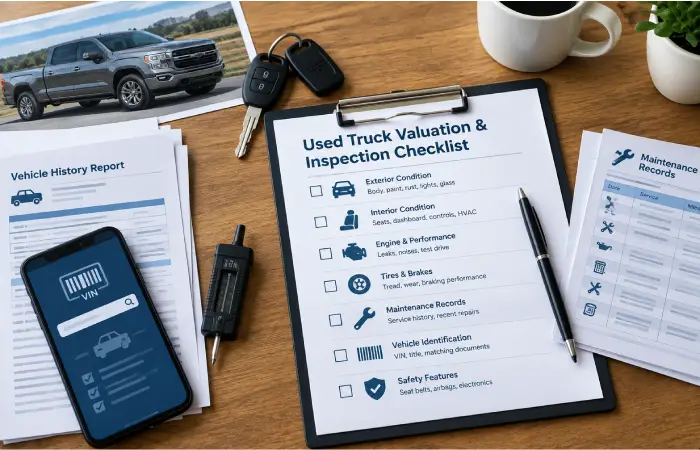
Used Truck Valuation Checklist
Before accepting an offer or buying a truck, check:
- Exact model year
- Make and model
- Trim
- Mileage
- Drivetrain
- Factory options
- Condition
- ZIP code
- KBB valuation
- Comparable local listings
- Vehicle history
- Title status
- Recalls
- Independent inspection
- Expected maintenance costs
FAQ’s
- What is Kelley Blue Book trucks used value?
It is an estimate of a used truck’s market value based on details such as its year, make, model, mileage, condition, equipment and location. The appropriate KBB value depends on whether you are buying, selling privately or trading the truck.
- Is KBB Trade-In Value the same as Private Party Value?
No. Trade-In Value relates to trading a vehicle with a dealer, while Private Party Value relates to a transaction between individuals. KBB explains that Trade-In Value will generally be lower because the dealer incurs costs associated with preparing the vehicle for resale.
- Does mileage affect a used truck’s KBB value?
Yes. KBB analyses mileage data and adjusts vehicle values when mileage is higher or lower than typical for the vehicle’s age.
- Does location affect KBB truck value?
Yes. KBB says its values account for geographic differences and local pricing conditions across U.S. regions.
- Can I use KBB to decide whether a used truck is a good deal?
Yes, but KBB should be one part of the decision. Compare the valuation with local listings, vehicle history, condition and an independent mechanical inspection.
- How often does Kelley Blue Book update used vehicle values?
KBB says it updates or verifies its used-car values and pricing at least weekly, although an update does not necessarily mean the value of every vehicle changes.
- Does KBB guarantee that I can sell my truck for its listed value?
No. KBB values are estimates. Actual offers and transaction prices can vary depending on condition, location, market demand, dealer costs and other factors.
Conclusion:
The best way to use Kelley Blue Book trucks used value information is to treat it as a reliable starting benchmark rather than a guaranteed selling or purchase price.
Enter the truck’s exact specifications, mileage, condition and ZIP code, then select the valuation that matches your situation. After that, compare the result with similar local trucks and investigate the vehicle’s history and mechanical condition.
For buyers, this process can help identify whether an asking price deserves closer attention. For sellers, it can provide a more realistic starting point for setting expectations. Either way, the strongest decision comes from combining KBB data with real-world evidence rather than relying on one number alone.