

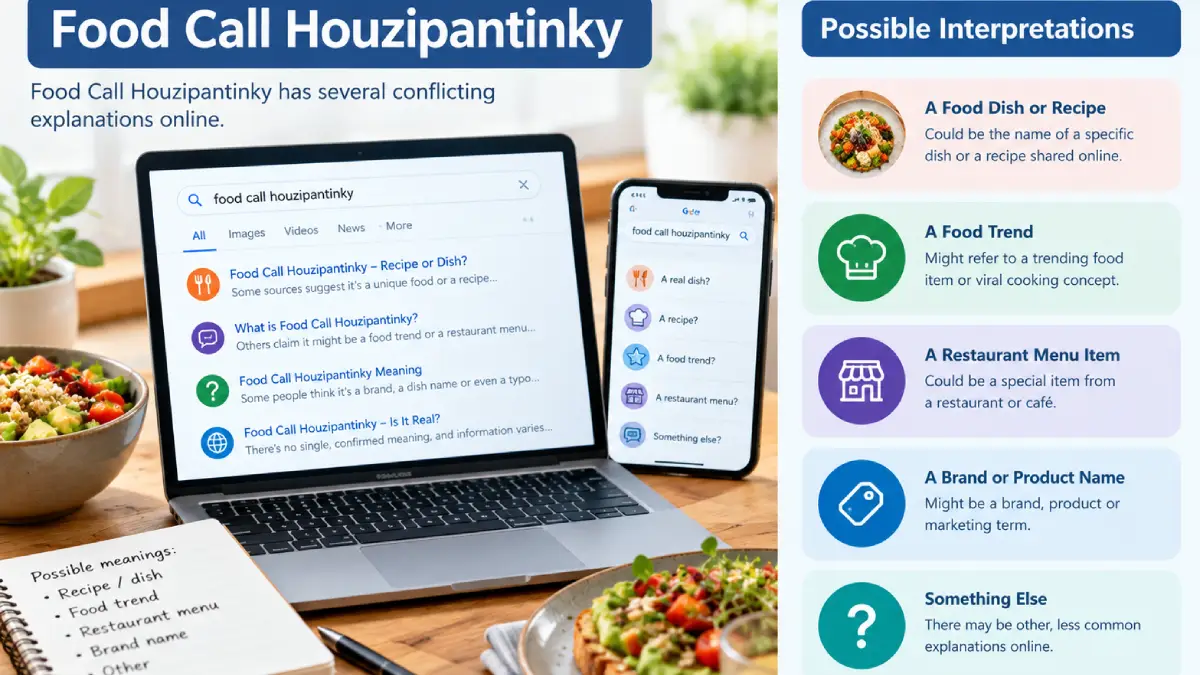
The phrase food call houzipantinky is unusual enough to raise an obvious question: is it the name of a real food, a culinary tradition, an online service, or simply a newly generated internet term?
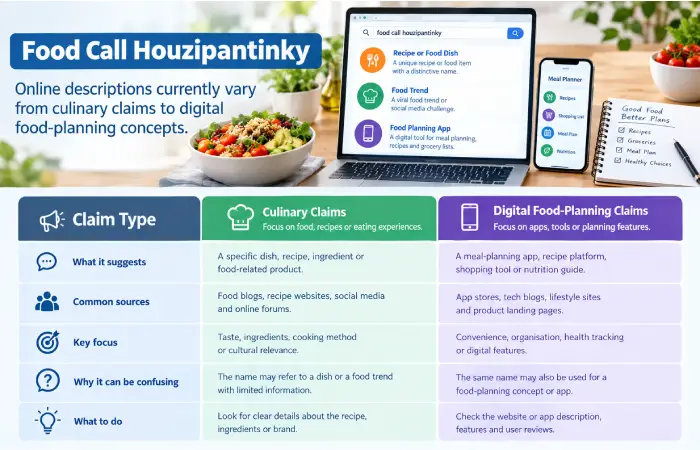
At the moment, there is no straightforward answer supported by strong primary evidence. Several websites have published pages attempting to explain the phrase, but their descriptions do not agree. One page describes Houzipantinky as a Czech dumpling and even attributes a supposed historical “food call” tradition to it, while other pages describe it as a meal-coordination or decision-support concept.
That inconsistency is important.
Rather than repeating an unsupported definition as fact, this guide looks at food call houzipantinky, what appears in current search results, what remains uncertain, and how readers can assess similar unfamiliar entities online.
Quick answer:
Food call houzipantinky is an ambiguous internet search term. Although some websites present it as a Czech food or culinary tradition and others describe it as a digital food-planning concept, there is currently insufficient authoritative evidence to establish either explanation as a verified fact.
Table of Contents
What Is Food Call Houzipantinky?
Food call houzipantinky does not currently have a universally accepted definition.
A search for the phrase produces several types of pages. Some present highly specific culinary descriptions, including claims that Houzipantinky is a traditional Czech dumpling. One such article describes ingredients, preparation methods and supposed regional “food calls”. However, the page provides no strong primary documentation for these historical claims.
Other pages give the term an entirely different meaning.
For example, one recently published article describes Food Call Houzipantinky as a digital service concerned with meal coordination, scheduling, inventory alerts and reminders. Another describes it as a decision-support framework for meal planning and sourcing.
These descriptions cannot all be assumed to refer to the same established entity.
That leaves three reasonable possibilities:
- The term may be a newly emerging internet phrase.
- It may be associated with automatically or independently generated content.
- It could refer to something very niche that has not yet been documented by authoritative sources.
For SEO purposes, this distinction matters because ranking for an unusual keyword should not come at the expense of factual accuracy.
Why Is Food Call Houzipantinky Difficult to Verify?
There are several warning signs when researching an unfamiliar entity.
1. Search results contradict one another
The most obvious issue is that different websites assign completely different meanings to the phrase.
One source describes a supposed Czech culinary tradition. Another describes a digital food-management service. A third presents the subject in almost entirely metaphorical culinary language.
When independent sources disagree this substantially, a writer should avoid presenting one interpretation as established fact without further evidence.
2. The sources are not clearly authoritative
The pages appearing for the keyword are largely general websites rather than recognised culinary institutions, academic publications, government organisations or established food references.
That does not automatically mean the information is false. It does, however, mean that the claims require additional verification.
3. Some pages contain suspiciously precise details
One article provides exact historical periods, geographical variations, vocal patterns, cooking temperatures and preparation measurements.
Specificity can make content sound authoritative, but precision is not evidence by itself.
A claim such as “the tradition was documented between 1850 and 1920” should ideally be accompanied by a traceable museum record, academic publication, archival document or other primary reference.
Without that supporting evidence, the detail should be treated cautiously.
Is Houzipantinky a Real Food?
This is probably the most important question for someone searching food call houzipantinky.
At present, there is not enough reliable evidence to confidently identify Houzipantinky as an established food recognised by major culinary references.
Some online pages do describe it as a Czech dumpling made from ingredients such as flour, eggs, milk, yeast and breadcrumbs.
However, finding a recipe on an individual website does not establish that the dish is historically authentic or widely recognised.
A useful verification process would involve checking:
- recognised Czech culinary references;
- Czech-language sources;
- academic publications on Czech food history;
- museum or cultural heritage collections;
- established cookbooks;
- reputable food institutions;
- historical archives;
- restaurant menus from credible establishments.
Until evidence from sources such as these is available, it is safer to describe the dumpling explanation as an online claim rather than a confirmed historical fact.
What Does “Food Call” Mean in the Keyword?
The wording “food call” adds another layer of uncertainty.
It could theoretically mean several things:
| Possible meaning | What it could refer to | Confidence |
| Food-related phrase | A phrase associated with a dish | Unclear |
| Meal announcement | A verbal signal that food is ready | Unverified |
| Brand/service name | A digital food-related service | Unverified |
| Search-generated phrase | A newly circulating keyword | Plausible |
| Culinary tradition | A historical practice | Not sufficiently documented |
The important point is that “food call” should not automatically be interpreted as a formal culinary term.
The meaning may depend on where the phrase originated and how people are using it.
Online Claims About Food Call Houzipantinky
Current search results show several competing narratives.
The Czech food interpretation
One article presents Houzipantinky as a traditional Czech dumpling and describes an associated “food call” tradition. It claims that the practice originated in rural Bohemian communities and gives several supposed regional variations.
This is an interesting interpretation, but the article alone is not enough to establish the history.
The meal-planning interpretation
Another source describes Food Call Houzipantinky as a digital service designed around meal coordination, scheduling, inventory tracking and reminders.
This is substantially different from the culinary explanation.
The decision-support interpretation
A separate article describes the term as a framework for meal planning, sourcing, portions and scheduling.
Again, this suggests that the phrase may be circulating as a content-generation or keyword phenomenon rather than representing one clearly established organisation or product. For more related articles visit our website.
How to Evaluate Food Call Houzipantinky Claims
If you encounter a website claiming to explain food call houzipantinky, do not judge its reliability purely by how detailed the article looks.
Use this simple workflow.
Step 1: Identify the claimed entity
Ask what the website says Houzipantinky actually is.
Is it:
- a food?
- a recipe?
- a cultural practice?
- an app?
- a company?
- a website?
- a fictional term?
- a new internet trend?
A clear definition should come before accepting additional details.
Step 2: Look for a primary source
If an article claims that the term comes from a particular culture, organisation or historical period, look for evidence from the relevant institution.
For a Czech food-history claim, for example, a strong investigation would look for Czech cultural, museum, academic or archival material.
Step 3: Compare independent sources
Do not rely on five articles that simply repeat the same claim.
If all five appear to have copied or paraphrased the same unsupported explanation, they do not represent five independent confirmations.
Step 4: Check dates
Recently published pages can be useful for understanding what is currently appearing in search results, but publication date does not establish historical authenticity.
Several pages currently ranking for the keyword appear to have been published recently.
Step 5: Separate facts from interpretation
A responsible article should distinguish:
Verified: supported by reliable evidence.
Reported: claimed by an online source.
Unclear: insufficient evidence to establish the claim.
This approach is especially useful for strange or newly emerging keywords.
Food Call Houzipantinky vs a Typical Food Entity
It is useful to compare the keyword with an established food entity.
| Factor | Established food | Food Call Houzipantinky |
| Recognised name | Usually established | Unclear |
| Standard definition | Generally available | Conflicting |
| Reliable recipes | Usually numerous | Limited/uncertain |
| Historical evidence | Often documented | Not established |
| Cultural references | Usually traceable | Unclear |
| Independent sources | Widely available | Limited |
| Commercial availability | Usually identifiable | Not established |
| Confidence | High when well documented | Low at present |
This does not prove that Houzipantinky is fictional.
It simply means that the available evidence does not currently justify treating it as a well-established food entity.
Is Food Call Houzipantinky an Internet Myth?
It may be tempting to call the term an “internet myth”, but that would also go beyond the available evidence.
A better description is an unverified or ambiguous internet term.
There is a meaningful difference.
Calling something a myth implies that it has been demonstrated to be false or fabricated. Calling it unverified simply acknowledges that sufficient evidence has not been established.
That distinction is important for responsible publishing.
If future evidence from a recognised culinary institution, historical archive or other authoritative source emerges, the interpretation of the keyword could change.
What Should Readers Expect When Searching the Term?
People searching for food call houzipantinky may encounter very different types of information.
They could find:
- supposed food definitions;
- recipes;
- cultural explanations;
- fictional or imaginative descriptions;
- technology-related interpretations;
- SEO-generated explanatory pages;
- articles repeating claims from other websites.
The practical lesson is simple: do not assume that every search result represents an established fact.
For unfamiliar entities, the quality of the source matters more than the confidence of its wording.
An article can sound extremely certain while still lacking evidence.
A Practical Research Workflow

If you are researching the phrase for a recipe, article or purchasing decision, use this process.
Search → Compare → Verify → Decide
1. Search
Start with the exact phrase:
“food call houzipantinky”
Then try variations such as:
“houzipantinky food”
“what is houzipantinky”
“houzipantinky recipe”
“houzipantinky origin”
2. Compare
Look for repeated definitions and major disagreements.
3. Verify
Trace important claims back to their original source.
4. Decide
Only then determine whether the term represents a genuine product, food, tradition, service or simply a developing online keyword.
This workflow is particularly useful for unusual terms that have suddenly started appearing in search results.
Can You Trust Every Recipe Described as Houzipantinky?
No.
A recipe may be perfectly usable as a recipe while its historical description is inaccurate.
These are two separate questions:
Can the recipe be prepared?
and
Is the recipe historically authentic to the claimed tradition?
An online recipe cannot automatically answer the second question.
If you are interested in trying a recipe associated with the term, treat it as an experimental or internet-sourced recipe unless its cultural background can be independently verified.
For food safety, normal precautions still apply: use fresh ingredients, maintain appropriate cooking temperatures and account for allergies and dietary requirements.
Who Should Be Cautious About the Term?
Extra caution is sensible for:
- researchers looking for historical information;
- publishers preparing factual articles;
- journalists;
- students;
- food historians;
- people with food allergies;
- consumers looking for a commercial product;
- anyone being asked to pay for a supposedly official service.
If a website claims to sell an official Houzipantinky product or service, verify the business independently before providing payment information or personal data.
An unusual name appearing in search results does not automatically mean that a legitimate company exists behind it.
Common Mistakes When Researching Food Call Houzipantinky
Mistake 1: Treating one article as proof
One webpage is not sufficient evidence for an unusual historical claim.
Mistake 2: Assuming search ranking equals authority
Search engines can return newly published, highly optimised or low-authority pages. Ranking does not mean that every factual statement has been independently verified.
Mistake 3: Repeating unsupported statistics
Some pages associated with unusual keywords use precise percentages or historical numbers. Such figures should be checked before publication.
Mistake 4: Confusing repetition with confirmation
Ten websites repeating the same sentence may still originate from one unsupported source.
Mistake 5: Overexplaining an uncertain entity
When evidence is limited, the strongest SEO article is not necessarily the one with the most invented detail.
A concise, transparent explanation can be more useful and more trustworthy.
Frequently Asked Questions
What is food call houzipantinky?
Food call houzipantinky is an ambiguous search term that appears in several online explanations. Some websites describe it as a Czech food or culinary tradition, while others present it as a digital food-planning concept. There is currently insufficient authoritative evidence to confirm one definitive meaning.
Is Houzipantinky a real food?
Some online sources describe Houzipantinky as a Czech dumpling, but that claim is not sufficiently supported by authoritative culinary or historical evidence in the sources currently available. It is therefore better described as an unverified food claim rather than established fact.
Is food call houzipantinky a website or app?
Some recent pages describe the term as a digital food-planning or meal-coordination service, but there is no clear evidence from an established official source confirming a recognised platform under this name.
Is Houzipantinky Czech?
One online article claims that Houzipantinky is connected to Czech cuisine and Bohemian food traditions. However, the historical claims require independent verification before the term should be described as an established Czech culinary tradition.
Is there an authentic Houzipantinky recipe?
Recipes have been published online under the name Houzipantinky, including preparations involving flour, eggs, milk and yeast. However, the existence of an online recipe does not independently establish its historical authenticity.
Why are there different explanations for food call houzipantinky?
The disagreement may indicate that the keyword is relatively new, poorly documented, or being used by different websites for different concepts. The current search landscape does not provide enough evidence to confidently identify one universally accepted meaning.
Should I trust websites claiming to explain Houzipantinky?
Treat such pages cautiously. Check whether the writer provides verifiable primary sources, identifies the original evidence and distinguishes documented facts from interpretation.
Final Verdict:
Food call houzipantinky is best approached as an ambiguous and currently unverified internet keyword.
There are online pages presenting Houzipantinky as a Czech dumpling and culinary tradition, while other pages describe it as a digital meal-planning or decision-support concept.
The conflicting descriptions are the main reason not to publish a definitive claim that Houzipantinky is a particular food, cultural practice, app or company without stronger evidence.
For readers, the safest approach is to check the source behind any specific claim. For publishers, the better SEO strategy is to acknowledge uncertainty rather than manufacture details to fill an information gap.
As more authoritative information becomes available, the definition of food call houzipantinky can be updated. Until then, transparency is more valuable than pretending that an unusual search term has a well-established history.