

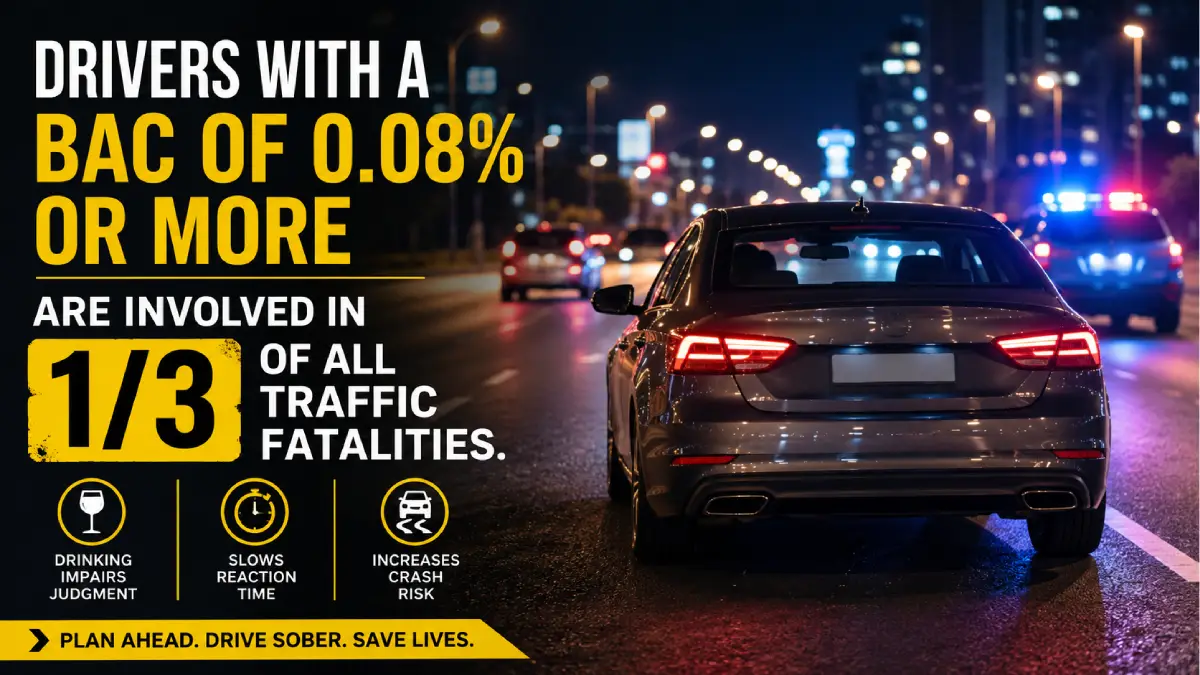
Drivers with BAC 0.08 percent or more are responsible for one-third of all traffic crash fatalities. A statistic which is frighteningly common and often quoted in driver-safety programs; however, even though this statistic is true, and one extremely crucial fact about alcohol impairment and car-crash related deaths, it varies by year and should be used with the appropriate data relative to year when possible and compared with the cliché and oft repeated “one-third.
“In the U.S., NHTSA reports that 11,904 died in alcohol-impaired-driving crashes in 2017-30 percent of all deaths on U.S. Roads last year.
That makes the safety lesson even more pressing: a large percentage of people involved in fatal accidents are too impaired to drive, and “too impaired” can occur long before you’ve had a drop too many.
Table of Contents
What Does BAC Mean?
BAC stands for blood alcohol concentration. It describes the amount of alcohol present in a person’s bloodstream and is generally expressed in the US as grams of alcohol per decilitre of blood.
For example:
| BAC | General significance |
| 0.00% | No measurable alcohol |
| 0.01–0.07% | Alcohol may still affect driving ability |
| 0.08% | Legal limit for most US drivers |
| 0.10%+ | Greater impairment and crash risk |
| 0.15%+ | Severe impairment and substantially elevated crash risk |
Remember not to regard numbers in this table as your own BAC calculator. Your BAC may be influenced by amount of consumption, rate of consumption, your physical makeup, food consumption and your metabolism.
NHTSA says no one can determine accurately whether one’s blood alcohol concentration is high or their level of impairment.
Why Is 0.08% Such an Important Number?
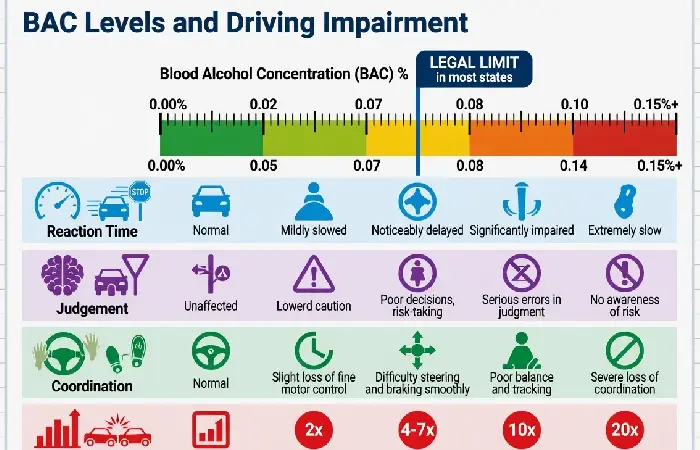
Currently, the legal BAC limit across most of the United States for drivers 21 and older is 0.08 g/dL. However, Utah is an exception to this, with a 0.05 g/dL limit. Your BAC will affect your driving abilities more slowly as it gets closer to the legal driving limit, but you do not want to wait for it to get that high.
Just remember that the legal limit should not be treated as your safe driving guideline The legal driving limit of BAC does not mark the point where intoxication begins.
Since alcohol influences your brain, it interferes with crucial driving mechanisms. NHTSA has found that as little as a few drinks can affect your ability to operate a vehicle. You do not want to treat the legal driving limits as a goal for what your intoxication level can reach before you stop.
Drivers With a BAC of 0.08% or More and Traffic Fatalities
The phrase drivers with a BAC of 0.08% or more are involved in 1/3 of all traffic fatalities is broadly consistent with historical US statistics, but it needs some context.
NHTSA’s current figures show that:
- 11,904 people died in alcohol-impaired-driving crashes in 2024.
- Alcohol-impaired-driving deaths accounted for about 30% of all US traffic fatalities.
- One person was killed approximately every 44 minutes in an alcohol-impaired-driving crash during 2024.
- NHTSA defines an alcohol-impaired-driving crash using a driver or motorcycle rider BAC of 0.08 g/dL or higher.
The CDC reports that 13,524 people were killed in motor vehicle crashes involving alcohol-impaired drivers in 2022, accounting for 32% of all traffic-related deaths that year.
So, depending on the year and dataset being discussed, the proportion can be around one-third.
Why the Wording Matters
There is an important difference between saying:
“One-third of all traffic fatalities are caused by drivers with BACs of 0.08% or more.”
and saying:
“About one-third of traffic fatalities occur in crashes involving an alcohol-impaired driver.”
The second statement is closer to how NHTSA and CDC describe the data.
A fatal crash involving an alcohol-impaired driver can kill the impaired driver, passengers, occupants of another vehicle or people outside vehicles. Therefore, the statistic describes fatalities occurring in crashes involving alcohol-impaired driving, rather than claiming that every individual death was directly caused by one particular driver’s BAC. For more related articles visit our website.
How Alcohol Changes Driving Ability
Driving requires several abilities to work together.
A driver needs to:
- Observe traffic conditions.
- Process information quickly.
- Make appropriate decisions.
- Maintain coordination.
- Control the vehicle.
- React when something unexpected happens.
Alcohol can interfere with several of these functions.
NHTSA explains that alcohol reduces brain function and can impair thinking, reasoning and muscle coordination. These abilities are essential for safe vehicle operation.
Reaction Time
A driver affected by alcohol may take longer to respond to a braking vehicle, pedestrian, cyclist or changing traffic signal.
At normal driving speeds, even a small delay can increase stopping distance and reduce the time available to avoid a collision.
Judgement
Alcohol can affect judgement and decision-making. A person may underestimate speed, follow too closely or believe that they are capable of driving when they are not.
This is particularly dangerous because impaired judgement can make the driver less aware of their own impairment.
Coordination
Safe driving requires precise control of steering, acceleration and braking.
Alcohol can interfere with coordination, potentially making it more difficult to maintain lane position or respond smoothly to changing road conditions.
Attention
Driving involves monitoring multiple things simultaneously: traffic ahead, mirrors, road signs, pedestrians, cyclists and other vehicles.
Alcohol impairment can reduce the ability to process these competing demands effectively.
Is 0.08% the Point Where Driving Suddenly Becomes Dangerous?
No.
Impairment does not suddenly appear when a breath or blood test reaches 0.08%.
The relationship is more gradual. As alcohol levels rise, driving-related abilities can increasingly deteriorate. NHTSA states that drivers with a BAC of 0.08 are approximately four times more likely to crash than drivers with a BAC of zero. At 0.15, crash risk is at least 12 times higher than for drivers with zero BAC.
These figures demonstrate why using 0.08% as a personal drinking target is unsafe.
A Simple Example
Imagine two people leaving a restaurant.
Driver A has consumed no alcohol.
Driver B has consumed alcohol but believes they are still alert enough to drive.
Even if Driver B does not feel noticeably drunk, alcohol may already be affecting reaction time, attention or judgement.
The safest decision is therefore not to try to calculate whether the driver is “under the limit”. Instead, arrange another way home.
Workflow: What Should You Do After Drinking?
A practical safe-driving workflow is straightforward.
Step 1: Decide Before Drinking
Arrange transportation before alcohol is consumed.
Options may include a designated driver, taxi, ride-hailing service or public transport where available.
Step 2: Do Not Rely on How You Feel
Feeling alert does not prove that you are unimpaired.
NHTSA notes that people often believe they are capable of driving when their alcohol has already affected them.
Step 3: Do Not Use Coffee or Food as a Driving Test
Coffee, a shower, fresh air or food should not be treated as methods for making an impaired person safe to drive.
Only time allows the body to metabolise alcohol.
Step 4: Hand Over the Keys
If alcohol has been consumed, someone else should drive.
The safest solution is to remove the decision from the person who may already have impaired judgement.
Step 5: Plan the Return Journey
A designated driver, taxi, ride-hailing service or another sober transportation option should be arranged.
NHTSA recommends planning ahead and choosing a sober driver or alternative transportation before drinking.
BAC Levels and Crash Risk: A Practical Comparison
The following table provides a simplified educational comparison.
| BAC level | Legal status in most US states | General driving concern | Practical decision |
| 0.00% | Legal | No alcohol detected | Normal driving if otherwise fit |
| 0.01–0.07% | Below the adult legal limit in most states | Impairment can still occur | Do not assume driving is safe |
| 0.08% | At or above legal limit in most states | Significant impairment and elevated crash risk | Do not drive |
| 0.10–0.14% | Above legal limit | Increasing impairment | Do not drive |
| 0.15%+ | Far above legal limit | Severe impairment and very high crash risk | Do not drive |
This is an educational guide, not a method for estimating an individual’s BAC.
The One-Third Statistic Has Changed Over Time
Traffic-safety statistics should always be tied to a year.
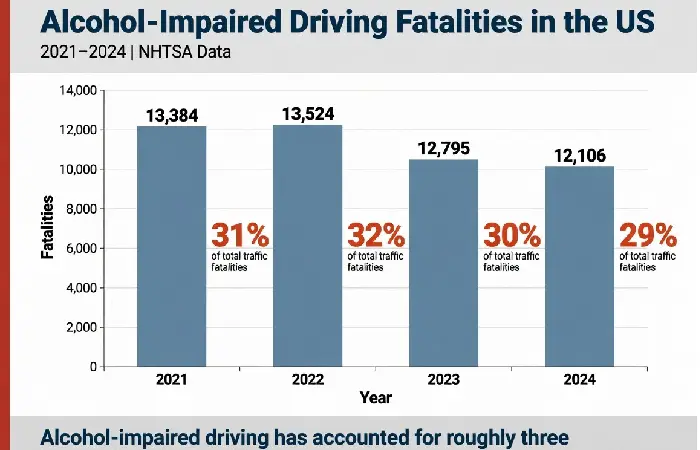
Older educational materials frequently state that alcohol-impaired driving accounts for about one-third of traffic fatalities. That figure was supported by several years of US data.
For example, NHTSA reported that alcohol-impaired-driving fatalities represented almost one-third of total motor vehicle fatalities in 2021.
The CDC reported a 32% share in 2022.
For 2024, NHTSA reports that approximately 30% of all traffic fatalities involved an alcohol-impaired driver.
Current Data at a Glance
| Year | Alcohol-impaired-driving fatalities | Share of traffic fatalities |
| 2021 | 13,384 | About 31% |
| 2022 | 13,524 | 32% |
| 2023 | 12,429 | About 30% |
| 2024 | 11,904 | About 30% |
Sources use slightly different publication dates and terminology, but the overall pattern is consistent: alcohol-impaired driving remains responsible for roughly three in every ten US traffic fatalities.
Why the Latest Number Is Better Than an Old Statistic
For road-safety education, using current statistics is preferable.
The “one-third” wording is useful because it is easy to remember, but it can give readers the impression that the proportion is permanently fixed.
It is not.
Fatality numbers change according to factors such as:
- Driving behaviour
- Enforcement
- Vehicle safety
- Road design
- Economic conditions
- Alcohol consumption patterns
- Seat-belt use
- Population changes
- Changes in reporting and data collection
For that reason, a credible automotive or driver-safety article should identify the year associated with a statistic.
Alcohol-Impaired Driving Affects More Than the Driver
One of the biggest misconceptions about drunk driving is that the risk belongs only to the person who has been drinking.
In reality, alcohol-impaired crashes can affect passengers, other drivers, pedestrians and cyclists.
CDC data from 2022 found that 59% of people who died in crashes involving alcohol-impaired drivers were the impaired drivers themselves. The remaining fatalities included passengers, people in other vehicles and non-occupants such as pedestrians.
This makes impaired driving a wider road-safety issue rather than simply an individual choice.
Alcohol-Related Crashes Can Occur Below 0.08%
Another important point is that alcohol-related traffic deaths are not limited to drivers who reach 0.08%.
NHTSA reported that in 2024, 2,028 people were killed in alcohol-related crashes where a driver had a BAC between 0.01 and 0.07 g/dL.
This does not mean that every one of these crashes was classified as an alcohol-impaired-driving crash under the 0.08 definition.
It does show why the legal threshold should not be interpreted as a guarantee of safe driving.
What Can Reduce Alcohol-Impaired Driving?
Preventing impaired driving requires more than telling individuals to be careful.
Evidence-supported measures include:
- Effective enforcement of impaired-driving laws
- Lower BAC limits
- Sobriety checkpoints
- Public education
- Designated-driver programmes
- Alternative transportation
- Vehicle and roadway technologies
- Measures targeting repeat offenders
The CDC identifies lower BAC limits and enforcement among effective approaches for reducing alcohol-impaired driving.
Technology is also being studied as part of future impaired-driving prevention. NHTSA continues to examine advanced technologies designed to prevent impaired drivers from operating vehicles.
Expectations: What a BAC Statistic Can and Cannot Tell You
Statistics are useful for understanding population-level risk, but they cannot predict what will happen to one individual driver.
A BAC figure does not tell you exactly how impaired a person will feel or behave.
Two people who consume similar amounts of alcohol may have different BAC levels because of differences in body composition, metabolism, food intake, drinking speed and other factors.
Likewise, a person who feels “fine” may still have impaired driving skills.
The safest expectation is therefore simple:
If alcohol has been consumed, do not drive.
Common Misunderstandings About BAC
“I am below 0.08%, so I am safe to drive.”
Not necessarily. Alcohol can affect driving ability below 0.08%.
“I can tell when I am too drunk to drive.”
Self-assessment is unreliable. Impairment can affect judgement itself.
“Coffee will sober me up.”
Coffee may make someone feel more alert, but it does not provide a reliable way to remove alcohol from the bloodstream.
“Eating prevents impairment.”
Food can influence alcohol absorption, but it should not be used as a reason to assume that driving is safe.
“The one-third statistic means exactly one out of every three crashes is caused by drunk drivers.”
Not exactly. The statistic refers to fatalities occurring in crashes involving alcohol-impaired drivers. It is not a statement that precisely one-third of all crashes are caused by drunk driving.
Who Should Pay Particular Attention to This Risk?
Every driver has the responsibility to recognize and seriously consider drinking and driving, yet there are some groups at added risk. As reported by the NHTSA:
younger drivers, males, and motorcycle riders, were identified as groups with significant impairment driving risks (FARS- National Highway Traffic Safety Administration, 2024).
Between 2020 and 2024 the age range 21-24% years, the higher percentage of impaired drivers involved in fatal crashes with 42% being impaired (NHTSA).
In 2024, 26% of motorcycle riders in fatal crashes had alcohol involved, based on a blood-alcohol level of .08 grams per deciliter or more (NHTSA, 2024).
Why This Matters for Everyday Drivers
It is not a fact to merely commit to memory for a driving test.
It makes a point that is much larger.
A driver may think it is fine for them to drive that short distance, it may be late with little traffic and they may think they have had long enough after a drink.
None of these is actually sufficient in order to indicate that it is fine to drive. It is much safer to arrange transport for the journey prior to having drunk any alcohol.
Frequently Asked Questions
Are drivers with a BAC of 0.08% or more involved in 1/3 of all traffic fatalities?
Historically, alcohol-impaired-driving fatalities have accounted for around one-third of US traffic deaths. Current NHTSA data shows that approximately 30% of US traffic fatalities involved an alcohol-impaired driver in 2024, while CDC data reported 32% for 2022.
What does a BAC of 0.08% mean?
A BAC of 0.08% corresponds to 0.08 grams of alcohol per decilitre of blood. It is the adult legal driving limit in most US states, although Utah has a lower 0.05 limit.
Can you be impaired below 0.08% BAC?
Yes. Alcohol can affect driving-related skills before a person reaches 0.08%. NHTSA specifically notes that even small amounts of alcohol can affect driving ability.
How many people died in alcohol-impaired-driving crashes in 2024?
NHTSA reports that 11,904 people died in alcohol-impaired-driving crashes in the United States in 2024.
Is 0.08% BAC the same as being drunk?
In US traffic-safety terminology, a BAC of 0.08 g/dL or higher is generally used to define alcohol-impaired driving for statistical and legal purposes in most jurisdictions. However, impairment can begin below this level.
Does a breathalyser tell you whether you are safe to drive?
A breathalyser can provide a BAC estimate, depending on the device and circumstances, but it should not be treated as permission to drive. The safest choice after drinking is alternative transportation.
What is the safest BAC for driving?
The safest BAC for driving is 0.00%. If you have consumed alcohol, arranging a sober driver or another form of transportation avoids the uncertainty involved in estimating impairment.
Final Takeaway
Drivers with a BAC of 0.08 percent or more, the legal limit, are responsible for about a third of all traffic deaths – though the specific percentage changes yearly. For example, new figures from NHTSA indicate that about 30 percent of American traffic deaths in 2019 were linked to drunk driving, with previous years coming closer to a third. The overall message is more significant than a specific percentage: Don’t wait until you’ve reached the legal blood alcohol content limit before considering the effects of alcohol.
Impaired driving ability can be compromised at levels below 0.08, and it is difficult to judge how a person is feeling at a given moment.
The only way to be completely certain is to not drive at all, and find another option such as a taxi, ride-hailing vehicle or designated driver.