

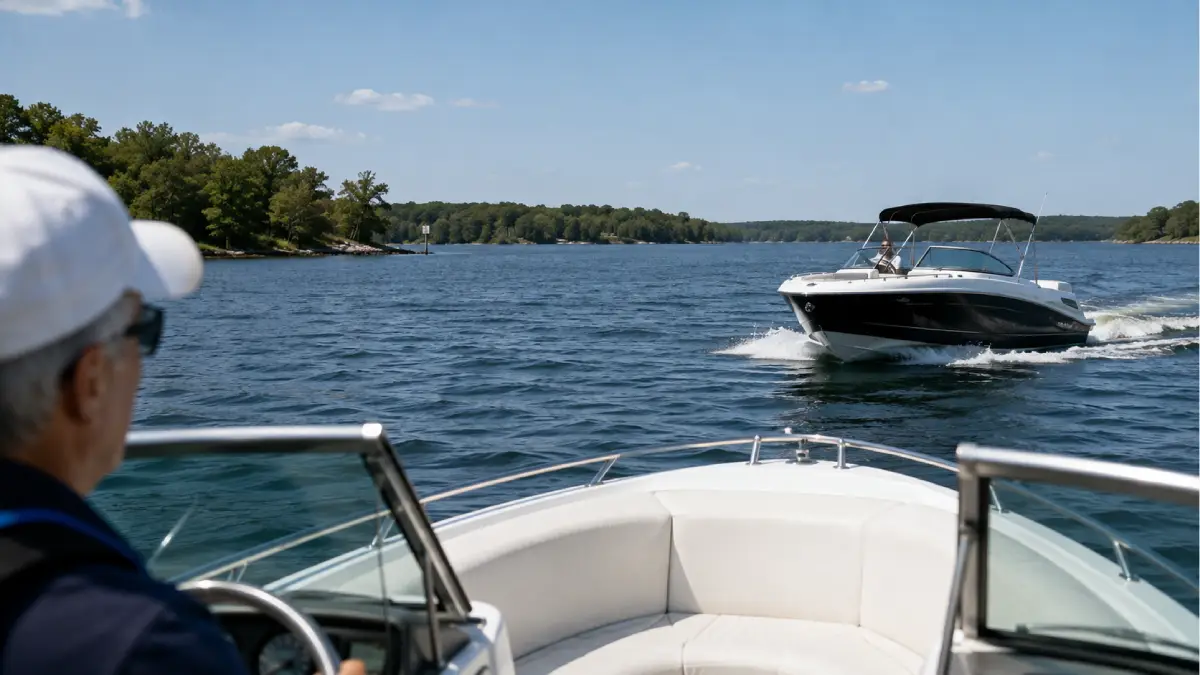
Boaters Should Stop if Facing Right of Another Motorboat Posted: Dec. 19, 2017 If you are boating and a motorboat heading toward you approaches on your right, it’s important to know how to prevent a collision. Basic boating navigation and right-of-way rules determine how to respond when boaters approach each other in this scenario.
The answer is: Slow down and give way to the motorboat.
When a motorboat you are approaching is on your starboard, or right, side, and there’s a danger of collision, your boat should normally yield to the motorboat’s right of way, according to Florida Fish and Wildlife Conservation Commission boating information. When you have the other boat to your right and they are crossing your path of travel, you should yield the right of way to the other boat and take action to avoid a collision.
You See a Motorboat Approaching on Your Right: Correct Answer
Answer: A. Slow down and give way to the motorboat.
This is also the answer provided in Florida’s official Boater Education test material.
The important principle is simple: if another powerboat is approaching from your right and the vessels are on crossing courses with a potential collision risk, you are the give-way vessel.
Your responsibility is to take early and obvious action to prevent the collision.
Table of Contents
Why Should You Give Way?
The navigation rules are designed to make encounters between vessels predictable.
If every boat operator made a different decision whenever two boats approached each other, the risk of collision would increase. Right-of-way rules establish which vessel should take action and which vessel generally maintains its course.
When the other motorboat is on your right, it has the preferred position in a crossing situation. You should therefore give it room to pass rather than attempting to cross directly in front of it.
Florida FWC specifically advises boat operators to yield to a boat on their right when crossing paths.
What Does “Give Way” Mean?
Giving way does not simply mean looking at the other boat and hoping it passes safely.
It means taking appropriate action to avoid a collision.
Depending on the circumstances, this can include:
- Reducing your speed
- Stopping if necessary
- Altering your course
- Allowing the other vessel to pass safely
- Maintaining a proper lookout
- Continuing to monitor the other vessel
The action you take should be clear enough that the other operator can understand that you are avoiding the collision.
What Is the Starboard Side of a Boat?
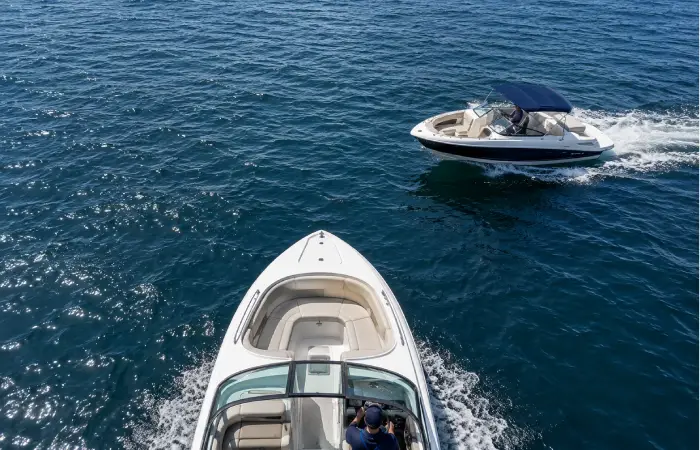
Starboard is the nautical term for the right side of a vessel when facing forward.
The left side is called port.
Remembering these two terms is useful when studying boating navigation rules.
| Nautical Term | Meaning |
| Starboard | Right side |
| Port | Left side |
| Bow | Front of the boat |
| Stern | Rear of the boat |
| Give-way vessel | Vessel required to take action to avoid collision |
| Stand-on vessel | Vessel that generally maintains course and speed |
A simple memory trick is:
Starboard = right.
Port = left.
What Should You Do When the Motorboat Approaches?
If you identify a crossing situation and the other motorboat is approaching from your right, take action early.
1. Stay Alert
First, determine whether the other boat’s course actually creates a collision risk.
Don’t focus only on the approaching vessel. Check for other boats, swimmers, obstacles, shallow water and navigation markers.
Florida FWC emphasises maintaining awareness of dangers approaching from any direction.
2. Reduce Speed if Necessary
If the boats are getting closer and there is a risk of collision, reduce speed.
Slowing down gives you more time to assess the situation and react.
3. Give the Other Boat Room
Do not attempt to squeeze in front of the approaching vessel.
Instead, take appropriate action to allow the other motorboat to pass safely.
4. Continue Watching the Other Vessel
Your responsibility does not end after making an initial manoeuvre.
Continue monitoring the other boat until the risk of collision has clearly passed.
Which Answer Is Correct in the Boating Test?
The question may appear with four options:
- Slow down and give way to the motorboat
- Maintain your same direction and speed
- Approach the boat so you will be able to jump its wake
- Increase your speed and pass in front of the motorboat
The correct choice is:
A. Slow down and give way to the motorboat.
The other options can create unnecessary risk. In particular, deliberately increasing speed to pass in front of another vessel is not an appropriate collision-avoidance strategy.
The official Florida Boater Education material lists option A for this question.
Crossing Situations vs. Head-On Situations
It’s important not to confuse a crossing situation with a head-on encounter.
Crossing Situation
When boats are crossing paths and the other vessel is on your right, you generally need to give way to that vessel.
Head-On Situation
When two power-driven vessels approach each other head-on, both vessels should manoeuvre to starboard. Florida FWC describes this as steering to the right.
Overtaking Situation
When one boat overtakes another, the overtaking vessel is responsible for keeping clear of the vessel being overtaken. Florida FWC advises overtaking vessels to pass with sufficient room and yield to the vessel being overtaken.
Understanding the difference between these situations is important when preparing for a boating safety test.
What If There Is an Immediate Collision Risk?
If the approaching boat continues toward you and a collision appears possible, do not simply wait for the other operator to react.
Take action to avoid the collision.
Florida FWC guidance states that when there is a threat of collision, a boat operator must slow down, stop or steer away.
The exact manoeuvre depends on the circumstances, including waterway conditions, traffic, vessel characteristics and available space. For more related articles visit our website
Why Maintaining a Proper Lookout Matters
Right-of-way rules are only useful when boat operators pay attention.
Many boating incidents involve collisions associated with operator inattention or carelessness, according to Florida FWC safety guidance.
A proper lookout means continuously scanning the water rather than focusing only on the direction in which your boat is travelling.
Before and during a crossing, look for:
- Other boats
- Personal watercraft
- Swimmers
- Divers
- Buoys and markers
- Floating objects
- Shoreline hazards
- Changing weather conditions
Being aware of your surroundings gives you more time to respond.
Common Mistakes to Avoid
When a motorboat approaches from your right, avoid these common mistakes.
Increasing Speed
Trying to accelerate past the other vessel can reduce your reaction time and increase the chance of a collision.
Cutting Directly in Front
Do not attempt to cross immediately in front of the boat that has the right of way.
Assuming the Other Operator Sees You
Never assume another boater has noticed your vessel.
Making Sudden, Confusing Movements
Your manoeuvre should be clear and appropriate to the situation.
Ignoring Other Hazards
Avoiding one boat should not put you on a collision course with another vessel, an obstacle or shallow water.
Quick Reference Guide
| Situation | General Action |
| Motorboat approaching from your right in a crossing situation | Give way |
| Head-on encounter between powerboats | Both steer to starboard |
| You are overtaking another boat | Give way to the boat being overtaken |
| Collision threat develops | Slow, stop or steer away as necessary |
| Other boat does something unexpected | Take action to maintain safety |
These are simplified educational principles. Actual navigation decisions depend on the circumstances and the navigation rules applicable to the waterway.
Frequently Asked Questions
You see a motorboat approaching on your right. What action should you take?
You should slow down and give way to the motorboat when the situation is a crossing encounter involving a collision risk. This corresponds to the answer provided in Florida Boater Education test material.
Does the boat on the right have the right of way?
In a standard crossing situation between power-driven vessels, the vessel approaching from your starboard side has priority, while you are generally required to give way. Florida FWC specifically instructs boaters crossing another boat’s path to yield to the boat on their right.
What does starboard mean?
Starboard means the right side of a vessel when facing forward.
Should you speed up to pass in front of the motorboat?
No. Increasing speed and attempting to pass in front of a vessel that has priority can create a dangerous situation. The appropriate response is to give way and take clear action to avoid collision.
What should you do if a collision becomes likely?
Take immediate action appropriate to the circumstances. Florida FWC advises boat operators to slow down, stop or steer away when there is a threat of collision.
What is the difference between port and starboard?
Port means the left side of a vessel, while starboard means the right side when facing forward.
Final Answer
If you see a motorboat approaching on your right in a crossing situation, the correct response is:
Slow down and give way to the motorboat.
Remember the basic rule: starboard means right, and in a crossing situation you generally give way to the vessel approaching from your starboard side. Always maintain a proper lookout and take early, clear action whenever there is a risk of collision. Florida FWC recommends slowing, stopping or steering away when necessary to prevent a collision.