

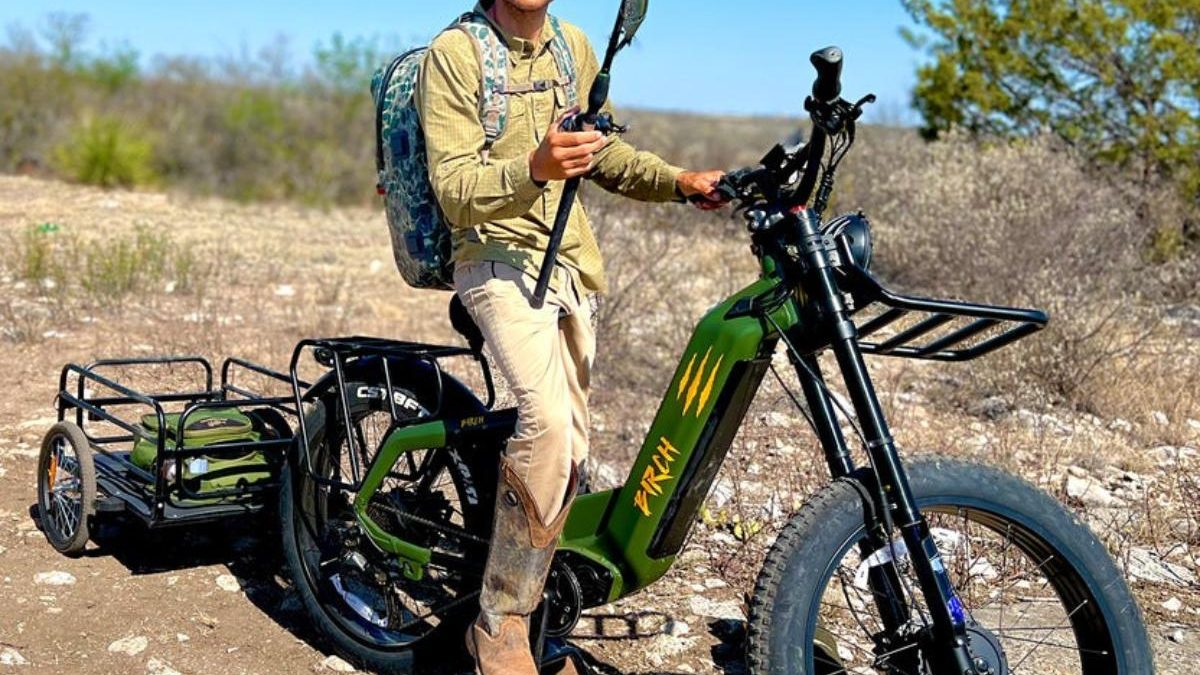
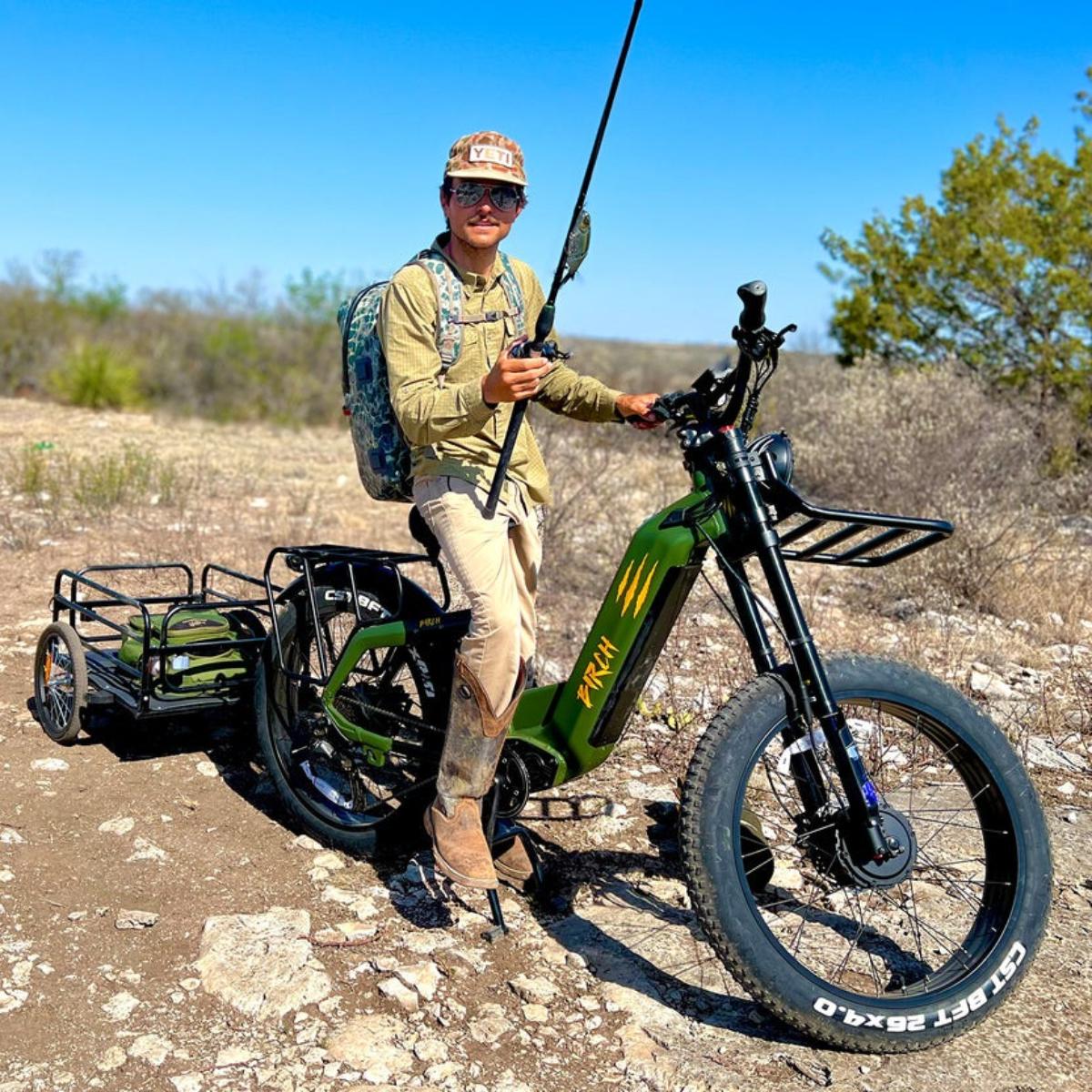
Whether you’re hauling a week’s worth of camping gear into the backcountry or packing out a trophy elk, adding a trailer to your setup transforms your e-bike into a true utility vehicle. However, towing 100+ lbs of dead weight changes the physics of your ride.
When you’re operating a high-performance dual motor ebike like the Birch Grolar, you have the torque to move mountains—but you need the technique to keep that power under control. This guide covers everything you need to know about riding an electric hunting bike with a trailer.
Table of Contents
1. Loading for Stability: The 60/40 Rule
Stability starts before you even turn the motor on. A poorly loaded trailer will “wag the dog,” pushing your bike around and making steering unpredictable.
- Center of Gravity: Always place the heaviest items (meat quarters, battery packs, or water jugs) directly over or slightly in front of the trailer axle.
- The 60/40 Rule: Aim for 60% of the weight to be in the front half of the trailer and 40% in the rear. This puts a small amount of “tongue weight” on the hitch, which keeps the trailer tracking straight and prevents it from bouncing or swaying.
- Secure the Load: Use high-tension ratchet straps. A shifting 100-lb load during a sharp turn can easily cause a tip-over.
2. Why a Dual Motor Ebike is the Ultimate Towing Machine
Towing with a single-motor bike can be a struggle on inclines. This is where the dual motor ebike shines.
The AWD Advantage
On a standard rear-wheel-drive bike, towing a heavy trailer puts immense strain on the rear tire. If you hit a muddy patch or a loose gravel climb, that rear tire can spin out.
With a dual-motor system like the Birch 2400W peak drivetrain, you have All-Wheel Drive (AWD). The front motor “pulls” the bike forward while the rear motor “pushes” the load. This 2-point traction system is essential for an electric hunting bike navigating off-camber trails with a full cargo trailer.
Conquering the “Lugging” Issue
Towing adds resistance. On a single motor, this often leads to “lugging”—the motor working at a low RPM under high load, which creates heat. A dual-motor system splits the workload, allowing both motors to run cooler and more efficiently, even with a 150lb trailer in tow.
3. Riding Techniques: Braking, Cornering, and Shifting
Riding with a trailer is more like driving a semi-truck than riding a bicycle. You have to anticipate the terrain much further ahead.
Braking: The “Reverse” Method
Normally, your front brake provides 70% of your stopping power. When towing, this changes.
- Avoid Jackknifing: If you slam the front brakes, the trailer’s momentum can push the rear of your bike sideways (jackknifing).
- The Technique: Engage your rear brake first to “tension” the trailer and slow the momentum of the load. Then, gradually apply the front brake to bring the entire rig to a stop. With the Birch’s dual-piston hydraulic brakes, you have the modulation needed for a smooth, controlled stop.
Cornering: Take it Wide
Your trailer does not follow the exact path of your tires; it “cuts the corner.”
- The Apex: Always swing wider than usual when entering a turn. If you take a tight turn near a tree or a rock, the trailer wheel is likely to clip the obstacle.
- Slow In, Smooth Out: Do all of your braking before the turn. Braking while cornering with a trailer can cause the trailer to push the bike’s rear wheel out of alignment.
Shifting Gears
Don’t rely solely on the motor’s PAS (Pedal Assist System).
- Downshift Early: If you see a hill approaching, shift your mechanical gears down before the incline starts. This keeps your cadence high and reduces the torque stress on your chain and motor.
4. Terrain-Specific Tips for Hunters
As an electric hunting bike user, you aren’t just riding on pavement. You’re dealing with the “Big Three”: Mud, Sand, and Slopes.
- Descending Steep Hills: This is the most dangerous part of towing. Use a low PAS level to provide “engine braking” and keep your speed under 10mph. If the trailer starts to sway, do not slam the brakes—increase your pedaling slightly to pull the trailer straight, then gently slow down.
- Mud and Snow: Drop your tire pressure on both the bike and the trailer to roughly 8–12 PSI. The wider footprint will keep the trailer from sinking like an anchor into soft ground.
- Log Crossings: If you have to cross a log, hit it at a 90^circ angle. If the trailer hits at an angle, one wheel will hop while the other stays low, which is the #1 cause of trailer flips.
5. Pre-Ride Checklist
Before you head 10 miles into the timber, perform this 30-second check:
- Hitch Security: Ensure the hitch pin is locked and the safety cable is attached.
- Tire Pressure: Check that trailer tires are firm (unless in soft sand/snow).
- Brake Test: Do a “drag test” in the parking lot. Pull the brakes at 5mph to ensure they can handle the extra weight.
- Balance: Lift the back of the bike. If it feels like the trailer is trying to lift the bike into the air, you have too much weight in the rear of the trailer (negative tongue weight).
Power + Precision
Towing with a dual motor ebike like the Birch Peak or Grolar makes the impossible possible. You can haul camp gear in and trophy game out without breaking a sweat—but only if you respect the physics of the trailer. Load it right, brake early, and let that 160Nm of torque do the heavy lifting.